Thursday, November 30, 2006

The Fascination of Genealogy: the Bryant Connection

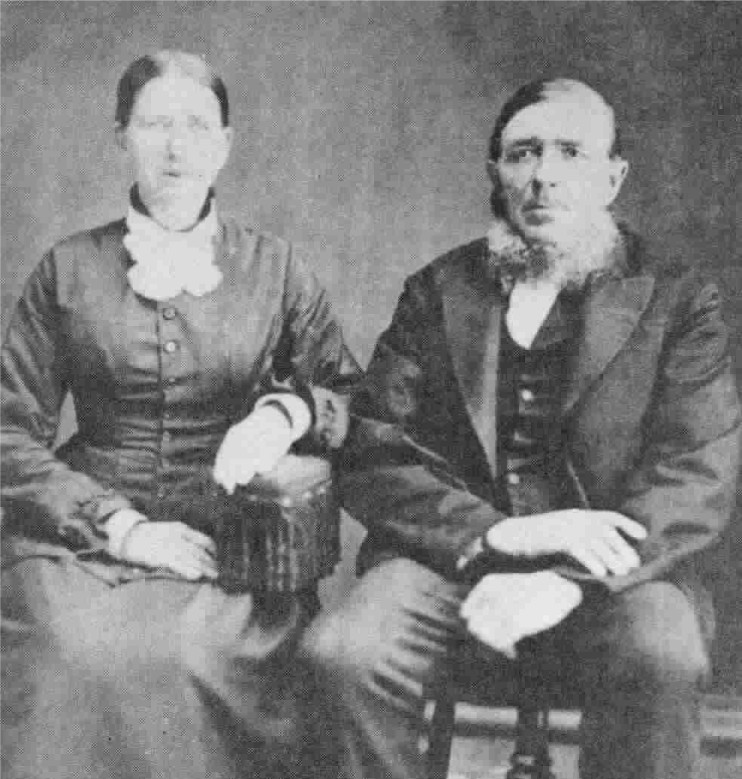
Here are my maternal grandparents, Edward Samuel Uhl, 1869-1928 (son of Joseph Alexander Uhl and Harriett Bryant Uhl) and Minnie Louise Blanchard Uhl, 1889-1978 (daughter of William Blanchard and Sarah Ludy Blanchard).


Once I discovered the family history of my German great-great grandfather John Adam Haag, I was hooked. I constructed a family tree on Ancestry.com, and I began to wonder about my other ancestors.

According to one fascinating family legend, my maternal great-grandmother Harriett Bryant Uhl was a descendent of a brother of American poet William Cullen Bryant. I never saw any proof of that, but it was a legend of great interest to my mother and me, both students of English and American literature.

If this legend were true, it would mean that my ancestry could be traced back to the Mayflower: Plymouth Colony residents Stephen Bryant and Abigail Shaw and John Alden and Priscilla Mullins, the latter couple immortalized by Longfellow. Can I prove this? No. Would it make any difference in my life if I could? No. However, I find all of this fascinating!

There are obvious problems. First, according to my Internet research, William Cullen Bryant had four brothers, Austin, Cyrus, Peter (aka Arthur), and John Howard. (He also had two sisters, Sarah Snell and Louisa Charity.) If one of the brothers was an ancestor of mine, which one?

Then, while the Bryant family, minus William Cullen, who remained in the East, and the father of the family, Dr. Peter Bryant, who died in 1820, did move west to Princeton, Illinois, in the 1830's, Harriett Bryant Uhl was born in Pennsylvania and later moved to Iowa with her husband and children. Did Austin, Cyrus, Arthur, or John Howard Bryant or any of their descendents ever live in Pennsaylvania? If not, there goes the story.

Who were Harriett Bryant Uhl's parents and grandparents? Will I ever find out? Stay tuned.

Copyright 2006 by Marlys Marshall Styne

Monday, November 27, 2006

Unknown Authors and Internet Reviewers

I've read good reviews, mediocre reviews, bad reviews, and mixed reviews. An unknown author learns to rejoice in all of them if they indicate that someone has at least read his or her book and expressed honest opinions of it. However, today I noticed what may be a new kind of review: the "I didn't really read the book, but I'll write a review anyway." I don't object to the negative parts of the review (it's not technically a "bad review") but to the fact that it clearly indicates ignorance of the book's contents and some very basic facts.

After correctly listing my name and the book's title, the reviewer repeatedly refers to me as "Dr. Stone." First, my name is not Stone, and second, I do not have a doctorate. Then he refers to my long teaching career at "St. Olaf's College." My father graduated from St. Olaf College in Northfield, Minnesota, and my brother taught there for many years, but I did neither. My forty-year teaching career was at Wilbur Wright College, one of the City Colleges of Chicago. The reviewer could have found the correct information on the back cover of my book. He even implies that I retired from my lofty position as a professor and then became a lowly secretary, and he wonders how I feel about that. Well, I do some secretarial work for a neighbor occasionally, but it's hardly a career--and the whole matter and how I feel about it are explained on pages 95-96.

The reviewer does say that I am a good writer (Thanks!), but he shows little understanding of what I tried to do or why. As an occasional book reviewer myself, I never review a book unless I've read 95% to 100% of it and formed some idea of who the author is and of his or her purpose. And I always take time to get the basic facts straight!

I shall not identify this reviewer or the relatively unknown web site, since I have no desire to recommend either, and fortunately, there are several more valid reviews of my book on the Internet. Were I to judge this reviewer as superficially as he apparently judged my book, I'd say that he's an intellectual snob who has a problem with older women who write--but that's not fair to say, is it?

(My title was suggested by Lord Byron's satirical poem "English Bards and Scotch Reviewers," 1809.)

Readers: how about adding some comments about this post and/or the art of book reviewing? Click on "comments" below.

Copyright 2006 by Marlys Marshall Styne

Wednesday, November 15, 2006

Tracing My Ancestors: Great-Great Grandfather John Adam Haag (with his second wife, Anna Margaretha Haag), 1883


I've often admired people who could trace their families back to the "old country," wherever that country was. I always said that I couldn't trace mine because of my mixed heritage (English, French, German) and the relatively early times all of my ancestors entered the United States. None of the relatives I knew spoke of any ties to any "old country," or if they did, I ignored them. I just wasn't interested.

Recently, on the occasion of cleaning out my messy home office for new carpet installation, I discovered a yellowed document entitled "Historical Sketch and Genealogy of the John Adam Haag Family," prepared by H. Arthur Haag and dated October, 1949. In 1949, I was a high school senior, and probably not very interested in my roots. I didn't recognize the name Haag or bother to find out what this document was about. I apparently just put it into the miscellaneous collection of things I moved around with me, even on my last move from my house. I thought I'd done a good job of "decluttering" then, but you'd be surprised at how much remains. This time, curiosity prevailed, and I decided to read about the Haag family. What I discovered was, indeed, interesting, now that I'm old enough to appreciate it.

John Adam Haag was born in Wildenthierback, Oberamt Gerabron, Kingdom of Wurttemberg, Germany, on September 29, 1819. He lived there until 1845, when, "unwilling to continue longer enduring oppression and tyranny" at home, he and a cousin emigrated to the growing village of Milwaukee, Wisconsin, to find freedom. He worked as a cabinet maker and studied English at night. Later John was joined by his parents and other family members, and the entire family soon moved forty miles west to Helenville in what is now Jefferson County. There was not even a road to Helenville, but the entire family walked on a blazed trail through a dense forest, a two-day journey. They assembled a fairly large portion of farm land near Helenville.

John Adam soon married Barbarn Gunz, and all of the Haag relatives built log cabins on their properties. They hunted squirrels and prairie chickens, raised vegetables, collected sap and made maple sugar and syrup. They raised grain and grew fruit trees. John Adam also made wagon tongues from the white ash trees on his farm and hauled them forty miles west to Madison to sell. As a cabinet maker, he was called upon to make caskets for the pioneer community, priced at $10.00 each. John and his sons cut cordwood to haul to Whitewater (my old home town) by sled and sell. Oxen were used as draft animals, horses being scarce there until the 1860's.

Barbara Gunz Haag died in childbirth in 1856, and a about a year later, John married Anna Margaretha Haag (not related). By 1868, the Haags had eleven children, and John Adam needed more room so that his grown sons could live nearby. The land around Helenville was all taken, and the liquor was flowing a bit too freely. John Adam Haag was not a teetotaler, but the staunch Lutheran worried about the moral climate. The whole family set out for the new frontier across the Mississippi, the fertile black prairie land of northeastern Iowa. They settled in Sumner, Iowa, where John Adam continued his farming activities and managed a cane mill, then very important for processing the sorghum or cane used to manufacture the molasses often used on bread and pancakes. He died at age eighty-eight in 1907.

The John Adam Haag clan featured large families and long-lived descendants. Here is where I come in: My great-grandmother was John's daughter, Maria Margaretha Haag Hoffman (1847-1930). My paternal grandmother was Maria's daughter, Rosetta Hoffman Marshall (1881-1957). My father was Rosetta's son, Clifford William Marshall (1905-1974). Maria Margaretha and her husband George Hoffman did not make the move to Sumner, Iowa, with her parents, so my family tree continued to grow in Wisconsin, never far from the old Haag homestead in Helenville.

Since I was born in 1932, I never knew the first or second generations traced by H. (Hugo) Arthur Haag in 1949, The author (b. 1883) was a nephew of my great-grandmother, the son of one of her older brothers, George Jacob Haag (1851-1936), so he was a cousin of my Grandmother, Rosetta Hoffman Marshall. I never knew H. Arthur Haag, and I'm sure he's deceased by now. However, I salute him for his efforts to trace this very large family, and I'm sorry I didn't know him when I was young.

Genealogy is an interesting science. Most of us hope to find famous people, royalty, heroes, or captains of industry in our backgrounds, and I've always thought that my English and French ancestors, little though I know about them, were more lively, talented, interesting people than the "stodgy" Germans. But to quote H. Arthur Haag, John Adam was "honest, sober, industrious and God-fearing . . . loved by his family and respected by his neighbors, " with the qualities of courage, leadership and initiative. "The Haags are plain, simple, honest people, not uppish or pretentious; well enough off in a material sense to be capable of taking care of themselves without following mean occupations, and poor enough to show that they are not grabbing everything in sight." Thanks, H. Arthur. Those are good qualities I'm happy to share.

Copyright 2006 by Marlys Marshall Styne

Saturday, November 11, 2006

Look Up in Awe: Washington Street Lobby, Chicago Cultural Center

Here are two views from my usual volunteer post at the Washington Street lobby information desk at the Chicago Cultural Center, 78 E. Washington. Originally the main entrance to the Chicago Public Library, this lobby is "a dazzling light-filled space finished with white Italian Carrara marble inset with sparkling mosiacs of glass, gold leaf, mother-of-pearl and precious stones," according to an official brochure. "The soft-surfacded marble came from the same quarries used by Michaelangelo for his sculptures."

The white marble staircase (upper photo) leads to Preston Bradley Hall, where library patrons once received their books. Today, various concerts and other events are held there, and the large Tiffany dome is one of the building's chief attractions.

The golden mosaic arches (lower photo) feature the names of great authors. I sit in the shadow of American authors Longfellow, Emerson, Whittier, Bryant, Hawthorne, and Irving, and the arch nearer the doorway features Homer, Plato, and others from the more distant past. I never tire of staring at all this beauty.

I also enjoy watching first-time visitors to the Cultural Center. It seems nearly impossible for anyone to enter for the first time without staring upward, open-mouthed in amazement that such a building exists in Chicago, and that they can explore and enjoy it at no cost. Nearly everyone snaps photos; last week, a visitor without a camera rushed out to buy one and returned to take her pictures. As you can see here, pictures hardly do justice to the magnificence of the place.

I direct visitors to the various exhibits, concerts, and special events taking place, to the Randolph Cafe, the Renaissance Court senior center, the gift shop, and even the restrooms at the other side of the building, and to the Chicago Visitors' Center, which offers an array of information about things to do in Chicago.

Cultural Center visitors are a picture of diversity: all nationalities, races, ages, and interests are represented. When they tell me what a wonderful building it is and how much they enjoyed their visits, I always smile and say "Thank you!" even though I can hardly take credit for their experiences. Don't miss this building on your next trip to Chicago; I think you'll understand why I enjoy sitting at the information desk at least once or twice a week.


Copyright 2006 by Marlys Marshall Styne
Photos by the author

Monday, November 06, 2006

A Brave New, Brand-New, Brand-You World?

When my former neighbor and long-time friend Margot Wallace told me that she had written a book entitled Museum Branding (AltaMira Press, 2006), my first question was, "What's that?" Margot teaches at Columbia College, Chicago, and she worked in advertising/marketing for many years before earning a master's degree and becoming a teacher in her field. She's good at what she does. She cheerfully explained to this outsider that museums need identities, or brands, to promote their institutions to visitors and benefactors. The book's subtitle is "How to Create and Maintain Image, Loyalty, and Support." O.K. Museum branding makes sense.

Still, when I encountered Jeninne Lee-St. John's article, "It's a Brand-You World," in the November 6 issue of Time, I was startled to learn about "personal branding." According to Ms. Lee-St. John, personal marketing consultants apply "the language, philosophies and strategies of Madison Avenue to the brand that is you." According to the experts she quotes, we need to be "packaged," our images overhauled, in order to get ideal jobs or to find life partners. "The majority of [job-seeking] kids coming out of college are essentially generic," according to consultant D.A. Hayden of Hayden-Wilder. As a long-time college professor, I question that, but I'll concede that some graduates may need advice: relax, don't say "uh" or "like" so often, dress appropriately, and so forth. But do they need to pay $2,950 for Hayden-Wilder's "Illumination" branding package? I don't think so. There's even a New York company, PersonalsTrainer, that will rewrite your on-line personals or dating service ad for $159.95!

I don't especially need or want either a job or a date these days, but this article interested me for two reasons: a short-lived experiment with a senior on-line dating site (no dates), and the publication of my book, Reinventing Myself: Memoirs of a Retired Professor, earlier this year.

I wasn't serious about the dating site for senior citizens. I just wanted to explore, and I wouldn't have minded meeting someone in my age group for coffee and conversation if, indeed, there are any seventy-ish men out there who are interesting, single, straight, healthy, and not looking for a housekeeper, cook, and/or nurse. I was truthful. I did not claim to be beautiful or vivacious or eager to find romance. The two or three tentative responders lost interest quickly, as did I. And when one mentioned sex as his main interest or activity, I concluded that he must hit the Viagra a bit too hard. Possibly a personal branding consultant could have improved my image and found me a date, but I might have told the guy to get lost. There's not much wrong with being single.

Then, there's my book. I've learned about marketing and publicity packages that cost many thousands of dollars: possible radio and TV interviews; book tours; public appearances. How about an image consultant for an "extreme makeover"? A media consultant to improve my radio or TV performance? No sale. My book is mainly for seniors, whom I assume to be quite oblivious or resistant to such efforts, and I do not expect it to be a best seller. Its readers have been appreciative, but it's a book with a limited audience. Why waste money on the impossible?

I've grown up believing that I should be myself and not care what others think. I'm an individualist and a loner. Those qualities have never made me popular, and perhaps they helped make me the depressed recluse I became for a while after my husband died; some reinvention was necessary. I've improved me teeth and my hair, and more importantly, become a volunteer, joined writers' groups, and made a few new friends. I've attempted to market my book on line (where many seniors never venture). But as for aggressive and expensive personal branding? I don't think so. I wouldn't mind meeting a few new people or selling a few more books, but I won't buy a new image in order to do so. I know who I am, and I'm content with the imperfect brand that is me.

Copyright 2006 by Marlys Marshall Styne

Saturday, November 04, 2006

Memories of the Past: Whitewater, Wisconsin


The first photograph shows me (on the left) with school friends Joan and Virginia sometime between 1947 and 1950. We are standing in front of the old log cabin that was moved to the campus of what was then the Whitewater Normal School, Whitewater, Wisconsin, in 1907. The log cabin still stood behind the main building many years later, during my years at the college "training school" and College High School. When we were young, the cabin served as a lesson in pioneer life for us.

I was reminded of the old log cabin when I read Fred G. Kraege's book Whitewater (photo on the right), published earlier this year as part of the "Images of America" series by Arcadia Publishing. The main college building burned a few years after my high school graduation, and the college, now the University of Wisconsin at Whitewater, is much different these days. The training school and College High are long gone, and I assume that the log cabin is too. Still, Kraege's book transported me back to my school days and my life in my home town from 1932 to 1950. See the August archives of this blog for an account of my most recent visit to Whitewater.

The author did an excellent job of collecting historical photos dating before, during, and beyond my years in Whitewater. He documents many of the changes I have observed in recent visits. I was happy to see a photo of the old City Hall, which I always found dark and mysterious, as well as ornate and romantic. The Whitewater skyline is much different without it. There's a picture of the old City High School, which we rather snobbishly referred to as "the other high school." In reality, of course, this was the town's main high school, while College High always remained small. Our school was not really elite, but we sometimes liked to think it was.

Churches and cemeteries are also featured in the book. First English Lutheran Church, which I attended for years, is described as a "prominent landmark today." I have either forgotten, or never knew, the church's history as first the Baptist Church and then the Norwegian American Lutheran Church. It was already First English Lutheran Church when I lived in Whitewater; the name refers to the language used, not the nationality of its parishioners.

While I could not find any references to my family in the book, I recognized enough streets and buildings to feel nostalgic. My grandfather, W. G. Marshall, owned a livestock farm on the outskirts of town (in an area once called Cold Spring, in Jefferson County) that my father, Clifford W. Marshall, later operated as a dairy farm. My paternal grandmother, Rosetta Hoffman Marshall, retired from the farm to a house on North Franklin Street just north of Main Street in Whitewater, a house that still exists. My mother, Violet Uhl Marshall, managed the Sears, Roebuck and Company Order Office on Main Street for sixteen years, during my high school and college years and later. She had begun college at Whitewater State Teachers College before I was born, and she finally graduated from what had become the University of Wisconsin at Whitewater in 1967, long after I had moved on.

I was eager to leave Whitewater, and I have had no close relatives living there for many years. Still, I have learned to appreciate my home town's history and beauty and the spirit of its early settlers. I'm glad I found this book!

Copyright 2006 by Marlys Marshall Styne

Monday, October 23, 2006

The Illinois Womans Press Association Book Fair


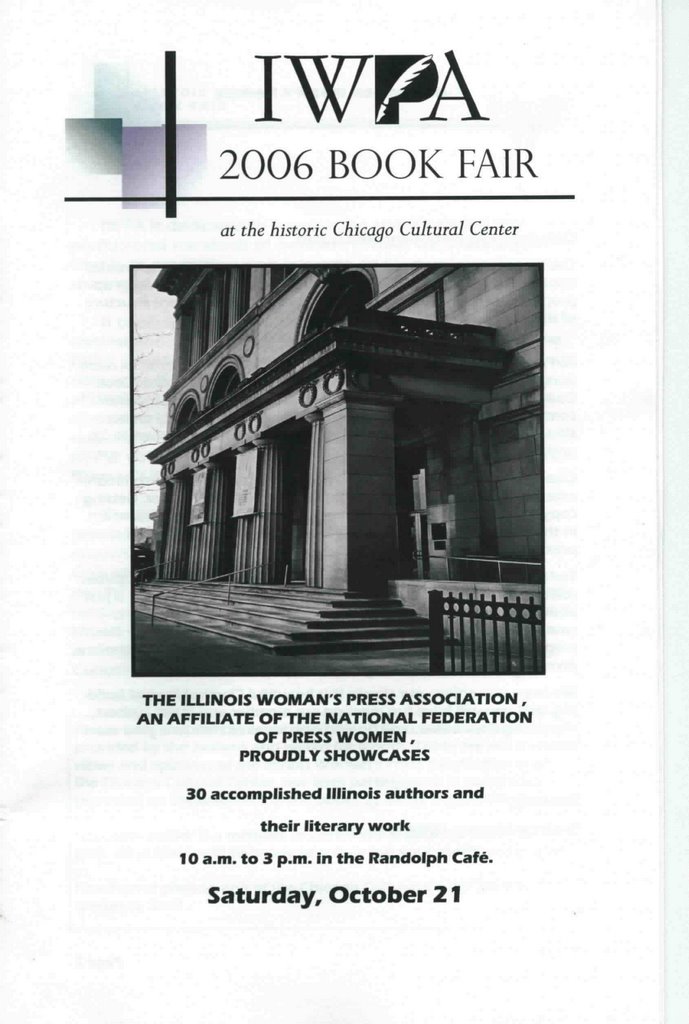
On Saturday, October 21, I was one of thirty Illinois authors, most of us little known, presenting our books at the annual IWPA fall book fair. This event was one of the many Book/Author events featured in the city's and the Chicago Public Library's Chicago Book Festival, October 2006. As a relatively new author, I enjoyed the fair very much. Does that mean that I sold a lot of books? No, but I still found the event very interesting.

For one thing, the setting, the Randolph Cafe of the Chicago Cultural Center, is a wonderful place. The Cultural Center itself, where I am often an information desk volunteer, is a building worth visiting for its architecture, mosaics, and marvelous Tiffany dome, as well as for the many exhibits and events presented there, most of them free and open to the public.

On Saturday, the cafe featured thirty large tables covered by purple cloths (the IWPA color), and each of us set up his or her own book and information displays. Fifteen of us were IWPA members, and the rest other authors and publishers from throughout the state. Many visitors passed our tables, and many stopped to chat with us and look at our books.

The emcee, Cheryl Corley of NPR's Chicago Bureau, did an amazingly efficient job of interviewing each of us on stage. She was able to interview thirty of us with interesting questions and good humor throughout. I'm sure that my lack of media experience showed in my interview, but Cheryl's skills really saved the day. I was impressed.

Another feature of the fair that impressed me was the diversity of both the authors and their books. Various races and ethnic groups were represented, and our books ranged from children's books to fiction to self-help to inspirational and spiritual topics, as well as other non-fiction titles. Chicago's diversity and the diversity of Illinois writing were on display.

The officers of the IWPA, including president Suzanne Hanney and event chair Marianne Wolf (also an author); my fellow Cultural Center volunteers; the staff of the Shop at the Cultural Center: all deserve praise and thanks for their hard work.

Get more information about IWPA and its parent organization, the National Association of Press Women, at www.iwpa.org or www.nfpw.org. I'll hope to see you at next year's fair!

Copyright 2006 by Marlys Marshall Styne

Sunday, October 15, 2006

Amazing Amazon!

If you haven't shopped for a book on Amazon.com lately, you should take a look. I am continually being amazed by the new features I find there. It's taken me a long time to discover the many things an author or publisher can do to promote a book and communicate with potential readers. Of course there are bare-bones publishers' listings on Amazon too, but I've had a lot of fun trying out the features, both old and new.

Of course I have a profile page with a picture and probably more facts than anyone wants to know about me. I have a "Listmania" list: "Inspiring and Interesting Books for Senior Citizens." I have forty-plus tags, from "aging" to "writing as therapy," to help readers looking for certain book categories, and I've added customer tags to other authors' books, too. I have a growing list of search suggestions in the "books for seniors" category. There are three customer reviews of my book (averaging 4 1/2 stars). I have written customer reviews for a few other books. I have references to this blog and to other web sites that mention my book, Reinventing Myself: Memoirs of a Retired Professor. All this is interesting--and free--but it's the newer features that really amaze me.

The "Search Inside" feature leads the way to the rest. With "Search Inside," the potential buyer can see large views of the front and back covers, the copyright page, the table of contents, and several excerpts. How do book listings get these features? Some publishers submit their books for "Search Inside," but authors can do so too. The only cost is a copy of the book, sent to a special address after Amazon has verified that you are, indeed, the author, with rights to the book. If the publisher retains the rights, it's up to him or her.

Just a day or so ago, I discovered four new additions to my Amazon listing: Condordance, Text Stats, SIPs, and CAPs. Perhaps only English teachers find such things fascinating, but at the very least, they show the power of computers. Concordance lists the one hundred most commonly-used words in the book, excluding the common "a," "an," "and," "the," and similar short words. The words are printed in sizes representing their prominence in the book. For my book, the largest is "time" (119 times), followed by "years" (99) and "remember" (98). That seems predictable for a memoir. By putting the mouse pointer over the word, one can find out how many times it was used, and by clicking on the word, one can see the page numbers and parts of the sentences in which the word appears! For example, "time" first appears on page three: "Having unusually well-educated parents for that time and place . . ." Why would anyone need to know this? For a book like mine, it's unlikely that anyone would care, but for a more scholarly book, the concordance could provide an easy way for a student or a writer to find relevant references. It's a new world out there.

Text Stats reveals information about readability, complexity, and number of characters, words, and sentences. It shows the book's standing on the Fog Index (11.8), the Flesch readability scale (56.3), and the Flesch Kincaid scale (9.8). My book is apparently about average in readability, as intended. These stats might be important for English or reading teachers checking on fiction or non-fiction books appropriate for their students.

Finally, what in the world are SIPs and CAPs? SIPs are "statistically improbable phrases." In my book, there is just one listed: "cat sitter." I wonder why that's so improbable? There are a lot of cat owners out there, and who takes care of our cats while we're out of town? CAPs are "capitalized phrases." Twenty-five are listed for my book, from "Old Town Pump" (my late husband's old place of business) to "St. Olaf College" (my late father's alma mater and the main location of my brother's teaching career).

Clicking on a CAP leads to information on what other listed books, if any, include that phrase. The "Signature Room" (one of my favorite Chicago restaurants) has two references in my book and three in Lonely Planet Chicago, by Chris Baty. "Wells Street" has five references in my book, and is also mentioned in at least twenty-two other books about Chicago. Clicking on a CAP also leads to a link to A9.com, where I found that most references to "Old Town Pump" refer to actual water pumps across the country, but number twenty-three is a quote from my book and a link to me!

I am fascinated and amazed by these features on Amazon.com, but it's too early to judge their effectiveness. I'm sure that the academic world, of which I am no longer a part, will let us know. My book's unimpressive Amazon sales ranking doesn't suggest any effect so far--but did you know that, according to Amazon's Fun Stats, my book offers 2,290 words per dollar (when sold at list price)? At the holiday discount price, you get 3,366 words per dollar!

Copyright 2006 by Marlys Marshall Styne

Saturday, October 14, 2006

Isn't Readability Important?

I have noticed what seems to be a new trend in printed materials: white or black or colored type on a colored background. Two recent examples: the Life magazine included with yesterday's Chicago Tribune and the back of the Chicago Cultural Center's October schedule.

The Sudoku game in Life was printed in brilliant yellowish-green with white numbers. My vision, as corrected with glasses, is good, but this game seemed impossible to deal with. In order to figure out what the other numbers should be, one needs to read the numbers already there.

The newly-redesigned Cultural Center schedule is generally attractive and informative, but why is the monthly calendar on the back printed mainly in black on a brown background? It's nearly unreadable, as one visitor pointed out yesterday. Many of our Cultural Center visitors are in my age group, and many have much weaker vision than I.

Perhaps this is another example of computer and color printer overkill. I remember that we once went crazy with beautiful but virtually unreadable type fonts on our new computers just because we could. Maybe this is more elderly "What's the world coming to?" but what's wrong with old-fashioned, readable black on white? Explain this new dark background trend to me, design professionals.

Postscript: I have received a few comments on this subject. Margaret Holt, of the Chicago Tribune, asked the Tribune's design director about readability, and he answered that designers are sometimes overly optimistic about printing capability. "What looks good on a 17-inch computer monitor won't necessarily look the same on newsprint." I should add that the Tribune did not produce the unreadable Sudoku puzzle I complained about; the puzzle simply appeared in the Life magazine which was included with the newspaper. I noticed this week that Life has not changed its ways. Oh, well. The puzzles look pretty, and perhaps they're there simply for decorative purposes. It certainly isn't hard to find more readable Sudoku puzzles to actually work on.

I had no official comment from the Chicago Cultural Center, but several people who work there, as well as visitors and other volunteers, agreed with me. The November schedule isn't back to black on white, but it features a calendar on a lighter background than the brown one from October.

Copyright 2006 by Marlys Marshall Styne

Monday, October 09, 2006

The "Express Yourself" Authors' Conference

From September 29 through October 1, I attended Infinity Publishing’s “Express Yourself” Authors’ Conference in Valley Forge, PA, near Philadelphia. Most conference attendees were those of us whose books have been published by Infinity, but the conference was for anyone interested in marketing his/her books, regardless of publisher.

This conference opened a new world to me: I listened to inspirational advice on how to market books, as well as some basic information about publishers large and small, traditional and untraditional. The speakers included many stars of the independent book marketing world: authors of marketing materials, designers of web sites, providers of publicity packages, even a copyright law expert. I was fascinated.

Does this mean that I can or will get rich by turning my book into a best seller? No way. Both my age and my lack on entrepreneurial spirit are against me. I’m sure that the speakers can sell almost anything to almost anybody, but that’s not me. Perhaps I’m too comfortable. Of course I’d like to sell more books, but for me, the necessary expenditures of time and money seem excessive—and probably futile.

Don’t get me wrong. I enjoyed the conference, and I learned a lot. I may try a few new book-selling strategies. There are plenty of them out there, including John Kremer’s 1001 Ways to Market Your Books, a book I own. I’ve used a few of Kremer’s easier tips, including Amazon.com’s tagging, author profile, “Inside the Book,” “Listmania,” and customer reviews, but 1001 ways? Talk about over-kill.

I admire the experts I heard: Kremer, Dan Poynter, Jerry Simmons, Penny Sansevieri, Brian Jud, Paul Krupin, and others. I enjoyed touring Infinity Publishing, as well as meeting its president, Tom Gregory, its vice-president, and other employees. I enjoyed seeing a few copies of my own book in the conference bookstore and on the publisher’s shelves. I enjoyed meeting some very interesting fellow writers and hearing about their books. They represent a wide variety of interests, experiences, and areas of expertise.

This conference made me happy to be an author, albeit a virtually unknown one, and reminded me how inspiring it is to learn new things, meet new people, and enter new worlds after retirement. But for me, it’s the writing, not the selling, that matters most.

Copyright 2006 by Marlys Marshall Styne