Showing posts with label Memories. Show all posts

Saturday, July 04, 2009

4th of July Nostalgia:


I first wrote this in 2007, and I repeated it last year. However, since it is my definitive memory of the holiday, it seems worth repeating again.


Parade Memories and July 4th at Grandma's


My paternal grandmother lived in town, and that was exciting to me as a child. I grew up on a farm with visions of big-city skylines in my head; Whitewater, Wisconsin, did not qualify, but I considered it a step in the right direction.The excitement there was the 4th of July parade.

As I remember, it began on Main Street and turned down North Franklin street to the city park. Grandma lived on North Franklin Street. I remember the joy of swinging back and forth on Grandma's front porch glider and admiring the passing bands and floats and marchers, feeling patriotic, and always munching on some snacks that my plump body surely didn't need.

As I look back, I realize that it wasn't much of a parade by today's standards. The "floats" began as farm wagons, trucks, cars, and even children's wagons, and the bands sometimes played out of tune. Still, the parade spirit was there. I loved the flags and the excitement.

As I recall, I've participated in only three or four parades during my lifetime. In those days on Grandma's porch, I dreamed of parading as an honored celebrity or Grand Marshal, but of course it never happened. In Whitewater, I wore an ill-fitting purple band uniform, played my clarinet, and marched with our fledgling high school marching band once or twice. Ours was the smaller of the town's two high schools, and as I remember, the larger one had a bigger, better band. I once rode on a farm wagon-based float that proclaimed "Education Reflects the Spirit of Liberty" on the side and featured an old-fashioned mirrored "crystal ball," dance hall style, in the center.

At Luther College, I remember riding on a homecoming parade float in a fancy new yellow gown. It rained that day, and what I remember best is that the dress was ruined by run-off from the blue crepe paper decorating the float. My parents were in the crowd to observe this spectacle. I can't remember either the theme of the float or the sponsoring organization, but it may have been either the drama group or the literary society.

Today, I enjoy parades vicariously on TV. I admire the flowers and the beauty of the Rose Bowl Parade floats, the hype and variety of the New York Macy's Thanksgiving Parade, and the marching politicians, commercialism, and enthusiasm of Chicago's many big parades. Still, no parade quite provides the excitement of being "downtown" on Grandma's small-town front porch, swinging back and forth and eating. That experience was a generator of big dreams.

Thursday, November 27, 2008

Thanksgivings Past and Present

As this year's Healthy Choice turkey dinner awaits in my freezer and the organizers of Chicago's Thanksgiving Day parade prepare for their 8:00 a.m. step-off, I have decided to rerun last year's post about Thanksgiving memories. This has been a trying year, but I take comfort in reviewing Thanksgivings past and present, joyous and not, in the hope that next year will be better. Happy Thanksgiving to all!

Here is what I wrote last year:

"I remember the hot kitchen, the wonderful smells, my grandma in her white "cooking dress" making sure that everything was just right. I remember the spotless white linen tablecloth and napkins, the polished silver, the gleaming china and crystal, the place settings arranged just right, no fork out of place.I remember the small family gathered about, just five of us, my father silent as usual, my mother trying to be helpful despite her barely-disguised dislike of her mother-in-law. I remember my brother impatiently waiting for the food, eager to escape to a more active atmosphere somewhere, perhaps a ball game with his friends if the weather was good. I remember sneaking just one more chocolate from the Whitman’s Sampler box that was a holiday tradition. I had no fear of "spoiling" my gigantic appetite when I was surrounded by such great smells!

"I remember my own little apartment kitchen, my husband struggling to cook everything on the tiny stove and in the tiny oven while I tried to find places for all the mismatched plates on the long, makeshift table with the slightly stained gold permanent press tablecloth. The napkins were paper.I remember the crowd of ten or twelve crammed into the little apartment, mostly the single patrons of my husband’s bar who had nowhere else to go for the holiday. Family Thanksgivings had been a tradition in my husband’s family, so this was an important day for him. I was as inept at cooking then as I am now, but he did it enthusiastically. Most of the guests were men, and they ate every crumb of food. We seldom had leftovers in those years. A few guests fell asleep immediately after dinner, usually on the floor if any space was available there.

"We continued this Thanksgiving dinner tradition for several years after we moved to our house nearby. It was not a large house, but we filled it with good food and holiday joy for many of the same guests, and a few more.

"I remember the year when we finally ran out of friends to invite for Thanksgiving dinner; everyone had a family and lived in the suburbs by then, while we were still a city family of two. We made reservations for dinner at the Signature Room at the top of the John Hancock Center. It seemed very expensive to my frugal husband, but he ultimately enjoyed the experience. We ate so much at the sumptuous buffet that we couldn’t eat much of the small turkey provided for us, so we took it home (as advertised and recommended). Jules made turkey soup and turkey sandwiches enough to last at least a week. I think we got our money’s worth that year.

"I remember our last Thanksgiving together in 1999. It was also my last Thanksgiving with my mother, who was eighty-eight years old by then and living in a retirement condo in Northfield, Minnesota. My nephew and his wife cooked dinner at their house, and two grand-nieces were there as well. The food was fine, but I remember little about it. My mother lived on until this year, and I always sent her flowers for Thanksgiving. However, I didn’t join her in Northfield for the holiday again.

"I remember mostly that my husband was not feeling well on Thanksgiving, 1999, that he left immediately after dinner to return to the motel to rest. That was very uncharacteristic of him; he was usually the life of the party. I was very worried. He seemed to feel better later, but it wasn’t long after our return home that his pancreatic cancer was diagnosed. He would die in March of the following year.

"I remember later Thanksgivings with a friend’s family, including her husband and her two daughters. That tradition, begun when Jules was still alive, ended when one of my friends’ daughters moved away and her parents began to visit her for Thanksgiving. I understood.

"This year [2007], I’ll enjoy my Lean Cuisine turkey dinner, watch parades on television, read, write, and feel content. I may even open a bottle of Chardonnay. I’ve come to terms with the changes brought by aging and the passing of time and loved ones, and it’s all right. However, I am happy to remember those Thanksgivings from the past and many more, the good and the bad. Life goes on."

Co9pyright 2008 by Marlys Marshall Styne

Sunday, September 07, 2008

Thoughts on Grandparents' Day

This day had no special meaning for me. Unlike most people my age, I have no children or grandchilden, and I've reached the age when I no longer have living grandparents to honor. Still, a photo from my mother's album reminded me of my maternal grandparents, Edward S. Uhl and Minnie Louise Blanchard Uhl.

This picture shows them early in the 1900's, probably before my mother was born. I never knew Grandpa Uhl. He died the week before my mother's high school graduation, so I know him only though her memories.

I did know Grandma Minnie, as we called her. My first memory of her was as a spirited widow who drove an old Chevy coupe with a rumble seat. As a child, I loved to ride in that rumble seat, wearing a scarf and sunglasses and pretending to be a famous movie star in disguise.

Later, our whole famiy visited her and her third husband on a small farm near tiny Scales Mound, Illinois. The things I remember best about those trips are the kerosene lamps and the outhouse (we'd always had electriciy and indoor plumbing at home in Wisconsin), a shed that suddenly collapsed with a bang one night while we slept, and a mysterious, boarded-up one-room school nearby. My brother and I loved to peer through the cracks to see this fascinating artifact from the past.

For her time, Grandma Minnie was a remarkable woman, a survivor. Despite her lack of economic advantages and education, she always worked hard, and coped with the loss of three husbands and eventually, of her only son, my Uncle Eddie. She did farm work, cooked, baked, cleaned, sold various products door-to-door, read, worked crossword puzzles very successfully in ink, and lived without many of the advantages I've always taken for granted until very late in her life. For her, the walk down the garden path to the outhouse was part of life, even in a time when it was a curiosity to the rest of us.

My father's family looked down on Grandma Minnie and her various husbands as virtually "trailer trash," but my mother and I always admired her spirit. Nothing seemed to get her down; there was no pretense about her. She lived to age 89, finally crocheting colorful flowers for charity at the small town nursing home where she spent her final days. I still have a few of those flowers.

Most of Grandma's grandchildren and great-grandchildren have attended college and achieved success beyond anything Grandma Minnie ever dreamed of. Perhaps those of us who have adopted veneers of sophistication and become accustomed to today's luxuries need grandparents' day to remember those who came before us. Grandma Minnie still lives in my memory to teach me that it's not the material things that count most.

Copyright 2008 by Marlys Marshall Styne

Saturday, August 09, 2008

We Need "Bread and Circuses"

I'll admit to being old and jaded, to having a "Been there, done that" approach to life. I seldom get excited about anything these days, especially celebrity antics and other "events" in popular culture. I must also admit, however, that once in a while something catches my attention and stirs my imagination. It's usually discovering a new book that seems to speak to me, or seeing some famous sight like the Parthenon or St. Basil's Cathedral in Moscow or China's Great Wall for the first time (and it's been quite a while since those personal "Wow!" moments).

This morning I watched a rerun of yesterday's opening ceremonies from the Beijing Olympics. I was amazed, astounded, and fascinated. Yes, I know that China has a deplorable human rights record, and I can't defend the country's politics. But I'm still naive enough to believe in the idea of all nations getting together in peace for sporting events. My 2001 visit to China, when this year's Olympics was merely the subject of promotional billboards, proved to me that China has much to offer the world.

Still, the surprising thing was how affecting the opening spectacle was. And I find it positive that basketball star Yao Ming, who earned fame and fortune in the US, serves as a sort of bridge between our two countries. I won't be watching many Olympics events; I'm not enough of a sports fan for that, but I can understand the appeal of the games. It makes me think of "Bread and Circuses." We all need our national pride and identity, even though no country, including ours, is perfect (I've never found another that I'd prefer, however).

According to The New Dictionary of Cultural Literacy, 3rd edition. 2002, this is where the term "Bread and Circuses" came from and what it means:

"A phrase used by a Roman writer to deplore the declining heroism of Romans after the Roman Republic ceased to exist and the Roman Empire began: 'Two things only the people anxiously desire—bread and circuses.' The government kept the Roman populace happy by distributing free food and staging huge spectacles (See Colosseum).

“'Bread and circuses'” has become a convenient general term for government policies that seek short-term solutions to public unrest."

I suspect that no matter how jaded we become, we still need to have our hearts stirred by events like the Olympic games and elaborate inaugurations and festivities of all kinds. The costumes, the pyrotechnics, the spectacles: in a sense, that explains the continued popularity of the British monarchy and the various events that can still stir our hearts.

In a world inundated by serious problems, it's refreshing to know that a few things can stir our hardened hearts. For us elders, watching on TV may be the only option, but that's all right. We still need our Bread and Circuses, and I'm happy to discover that I can still appreciate them.

Friday, July 25, 2008

Reminders From a Distant Past

This is a cocktail napkin from the Old Town Pump, arguably the first "singles bar" in Chicago (it opened before the famous Butch McGuire's). It was located in Chicago's Old Town, not far from where I live now, from the late 1950's through most of the 1960's. It was sometimes known as a post-college "rah-rah" bar, where the boys often wore plaid bermuda shorts and the girls, beehive hairdos.

My late husband Jules was a co-owner, bartender, and guiding spirit behind this place; running it was a highlight of his life. It was a part of his life that he talked about until the end. He made many lasting friendships there, and so did I.

I met him there in 1964 (no, I wasn't much of a drinker or bar person, but the Pump was like a social club). We didn't marry until 1970, when the Pump was only a fond recent memory.

During the past two weeks, I have been reminded of the Old Town Pump by two things: a dinner with four old friends from those days (old as in both age and time, although I am a bit older than the others) and an encounter with the Old Town Pump slides, the pictures I took there of parties, Old Town Art Fair celebrations, and other days and nights of revelry. Taking pictures was my way of feeling useful, since a full evening of drinking beer was far beyond my capacity.

The dinner (the same group, with a few variations, has met occasionally in the last few years) was a nostalgic occasion. I believe that four of the five of us met our husbands at the Old Town Pump; one never married. Of the rest, only one has a living husband. Three of us are widowed. Two have grown children; those two also have grandchildren. All but one of us are retired from a variety of careers. All but one of us seems to walk with difficulty; we're all a bit overweight. We are all reminders of the passage of time.

The dinner conversation was punctuated by "Do you remember such-and-such an event or person? Do you remember when (so-and-so) did . . . ?" That brought up memories of the OTP slides, which were frequently shown during events at the Pump. While slides were the medium of choice then, I long ago switched to color snapshots, and finally, to digital photography. The old slides sat in my closet and gathered dust.

Fate intervened in the person of a lovely young woman, the daughter of another, somewhat younger Old Town Pump couple. She found me on line through my books and my blogs, and emailed me to ask about OTP memorabilia for her parents' wedding anniversary--the 40th, I think. Lisa came over to look at the slides, and I gave them to her. She had them copied onto a DVD, with music. Relieved by her help in clearing out my messy closet, I forgot all about the slides until that dinner with the "old guard."

I found Lisa's email address and asked for copies for myself and the others. She graciously agreed to bring over copies, and we watched the presentatioon together. There were the years 1966-68, when I was in my thirties and reasonably attractive--except for one picture of me with a cigarette hanging out of my mouth! I hardly ever smoked. I must have been a bit crazy then. There were pictures of people I haven't seen since the sixties, many of them now deceased.

There, of course, was my late husband, young, handsome, and smiling. In a way, the slides were reminders of the passing of time and of my aging. However, I was able to chuckle at the way we acted and dressed then. It was a different world, one I'm glad I experienced. I'm much different now, and I'm glad that I'm still around to see this DVD. I await my friends' reactions, and I've been told that this DVD may be posted on You Tube. If it is, I'll post a link here. We all need to explore where we've been. Doing so makes it easier to deal with an uncertain future.

Copyright 2008 by Marlys Marshall Styne

Friday, July 04, 2008

July 4 in Whitewater, Wisconsin, Revisited

Since my Independence Day experiences from childhood seemed to be much the same from year to year, I'm taking the liberty of reprinting my blog post from one year ago. The photo, borrowed from the Whitewater Banner on line, is entitled "Clown Parade," and it's from the 2007 parade in Whitewater, Wisconsin, my old home town.

This year? As I did last year, I'll enjoy the festivals and fireworks of the weekend on TV, happy to avoid the crowds. Those days on Grandma's porch are long gone, but I hope such days still exist for small-town children today. I still remember the excitement!

Here's what I wrote a year ago:

Parade Memories and July 4th at Grandma's

My paternal grandmother lived in town, and that was exciting to me as a child. I grew up on a farm with visions of big-city skylines in my head; Whitewater, Wisconsin, did not qualify, but I considered it a step in the right direction.The excitement there was the 4th of July parade.

As I remember, it began on Main Street and turned down North Franklin street to the city park. Grandma lived on North Franklin Street.I remember the joy of swinging back and forth on Grandma's front porch glider and admiring the passing bands and floats and marchers, feeling patriotic, and always munching on some snacks that my plump body surely didn't need.

As I look back, I realize that it wasn't much of a parade by today's standards. The "floats" began as farm wagons, trucks, cars, and even children's wagons, and the bands sometimes played out of tune. Still, the parade spirit was there. I loved the flags and the excitement.

As I recall, I've participated in only three or four parades during my lifetime. In those days on Grandma's porch, I dreamed of parading as an honored celebrity or Grand Marshal, but of course it never happened. In Whitewater, I wore an ill-fitting purple band uniform, played my clarinet, and marched with our fledgling high school marching band once or twice. Ours was the smaller of the town's two high schools, and as I remember, the larger one had a bigger, better band. I once rode on a farm wagon-based float that proclaimed "Education Reflects the Spirit of Liberty" on the side and featured an old-fashioned mirrored "crystal ball," dance hall style, in the center.

At Luther College, I remember riding on a homecoming parade float in a fancy new yellow gown. It rained that day, and what I remember best is that the dress was ruined by run-off from the blue crepe paper decorating the float. My parents were in the crowd to observe this spectacle. I can't remember either the theme of the float or the sponsoring organization, but it may have been either the drama group or the literary society.

Today, I enjoy parades vicariously on TV. I admire the flowers and the beauty of the Rose Bowl Parade floats, the hype and variety of the New York Macy's Thanksgiving Parade, and the marching politicians, commercialism, and enthusiasm of Chicago's many big parades. Still, no parade quite provides the excitement of being "downtown" on Grandma's small-town front porch, swinging back and forth and eating. That experience was a generator of big dreams.

Copyright 2007 by Marlys Marshall Styne

Sunday, June 15, 2008

Remembering My Father: Clifford W. Marshall, 1905-1974

In my book Reinventing Myself, I described my father as an enigma. He seemed to live in my mother's shadow. Like me, he was quiet and reserved; like me, he apparently suffered from clinical depression for much of his life, or at least that's my unofficial diagnosis or my explanation for his being the way he was.

As I look back, I realize that Clifford William Marshall was a good man, forced to be a farmer during poor economic times while he dreamed of better things. He never "made his mark on the world" in any way that befitted his intelligence and his college degree (in an age when college degrees were rarer).

My father was easy to overlook or ignore, but I realize now that he was a good man who did his best to meet his responsibilites. If he was sometimes reclusive and unpleasant, he probably had reason to be. He was browbeaten by his mother, and to a lesser extent, by his wife, my mother. I don't blame her; she did what she had to do to cope with life.

My father, pictured on the left (above) in about 1933 with my mother and me, had red hair, which I always coveted. Later, he grew bald, and he put on weight because of his unhealthy eating habits: a daily pint of ice cream at bedtime will do that to you. He also developed heart disease and diabetes toward the end of his life, and suffered a major stroke. He died at age 70 when he suddenly fell from the motor scooter he was riding along a snowmobile trail in northern Wisconsin. I missed his funeral; my husband and I were in London at the time, and couldn't get back in time.

My father was a kind man. He befriended an alcoholic acquaintance and tried to help him in an ultimately futile struggle to remain sober. He never drank himself, but he smoked for many years in an age when the dangers of smoking were not as well known as they are today. He took me for a boat ride on a northern Wisconsin lake once; we didn't talk much, but I remember that he was amused at my adult fear of water, my inability to swim, and my insistence on wearing a life jacket.

What else can I say? Here are the last lines of my chapter about him in Reinventing Myself: "Maybe he was even proud of my brother and me. Maybe under his quiet demeanor and his lack of communication, he knew some secret joy. My brother pities him as a victim of a dominating wife and a domineering mother, but I see him now as a victim of clinical depression that was never diagnosed or treated. I wish I'd had a chance to know him better--but perhaps I wasn't paying enough attention."

Copyright 2008 by Marlys Marshall Styne
Photo from the family collection

Tuesday, June 10, 2008

A Nostalgic Look Into My Past

Imagine my surprise to discover a reference to a 1976 book, long out of print, that includes my late husband and me! In "The secret to turning two dozen bucks into half a dozen cool books" (Tempo section, June 9), Chicago Tribune reporter Patrick T. Reardon tells about spending $23.95 at last weekend's Printers Row Book Fair. It's a great place to find both the new and the old.

One of his choices caught my attention: City Families: Chicago and London, by photographer Roslyn Banish. The book features families from one London and one Chicago neighborhood, along with brief interviews. The Chicago neighborhood featured is Lincoln Park, and I got out my old copy of the book to take another look, especially at pages 166-167.

There we are: "Marlys and Julian Styne. Mrs. Styne: College English teacher. Mr. Styne: Federal marshal." We talk a bit about our family beginnings and our lives. Our confidence and optimism are remarkable as we fail to answer the author's request for three wishes. Here is our reply: "Mrs. Styne: I don't think I coud think of three things I want, except more of the good life we've had. Mr. Styne: I think we're at the point in life now where we have the rewards of our work. We don't have the things to worry about that young families have. Mrs. Styne: We feel now that we can do pretty much what we want to, within reason." Yes, I had the last word, as usual. There we are at ages 44 and 48, seemingly without a worry in the world.

Perhaps even more memorable are Banish's two photographs of us. The first shows us seated on our living room sofa (gold velvet, as I recall, although the photo is in black and white). On the coffee table in front of us are newspapers and magazines and a snack tray. I can't tell what we had been eating. The antique lamp is one I still have (actually, I had two of them then, but the china base of one of them has since shattered). The wall behind us holds four old pictures from my family and one painting I actually did myself (not a good one, I might add). The ancestral pictures hang in my condo now, although not in the living room. My painting has been relegated to a closet, where it belongs.

The second photo shows us seated on a Kawasaki motorcycle in front of the house. The little house on Cleveland Avenue looks neat and tidy: white shutters, smooth parkway grass, black wrought iron fence. Toward the end of my stay there, it didn't look that good. The house next door, not yet updated then, looks much better today. Perhaps our old house does too; I haven't passed by in a while.

Both photos show my husband's dark, bushy mustache and graying, receding hair. My hair is longer than usual, and curly. Fortunately, that was one of my thinner periods, so I look old-fashioned (now), but not bad. Our clothing is nondescript; we obviously didn't dress up for the occasion, except to add motorcycle boots and carry helmets for the second picture.

What a picture of the mid-seventies! As I recall, Lincoln Park home prices were already rising quickly (we bought our little delapidated house for $17,500, although we spent a lot more than that to renovate it), and we were happy with our relatively carefree lives.

Of course nothing lasts. We replaced that Kawasaki with a series of BMW motorcycles, and our first European motorcycle trip came later in 1976. That's the trip on which I broke a leg, so nothing's perfect. We both eventually completed our careers and retired optimistically, but Jules died in 2000, leaving me depressd for a while.

All in all, while that mid-life smugness seems exaggerated, we need surprise reminders like Reardon's article to remind us about how things were. I've changed a lot in thirty years, and while I'm no longer that optimistic (or that thin), I'm happy to be reminded of the life I've had. I'm also happy that I'm still alive and able to revisit this book. This is another reminder of the lasting power of the written word--and of photographs.

Thursday, February 14, 2008

Happy Valentine's Day


I guess this is another of those holidays kept alive by the greeting card companies, but I like the idea of letting one's significant other, if any, know that you love him or her. Appreciation is always in order.

Now, eight years after the death of my own "Valentine," I can only remind those still fortunate enough to have partners to say a simple "I love you!"
My husband Jules and I were not much for exchanging gifts; we were the kind of independent people who always went out and bought ourselves pretty much whatever we wanted. Due to our differences, finding that "perfect gift" was nearly impossible.

On Valentine's Day, we usually ate out at an upscale restaurant (I guess we often ate out anyway, due to my distaste for cooking), and I remember that we usually exchanged Valentine cards. They were simple ones; we were usually too busy to spend much time choosing. We weren't a sentimental pair, but somehow, the valentine sentiments hit the mark. I even created a valentine on my computer occasionally. I wish he were here today so that I could say "I love you" again, but life goes on.

Just remember: it's not the quality of the card or gift that counts, or the number of stars in the restaurant's rating. What really counts are those three little words. Anyone can say them; be sure you do, with feeling. I LOVE YOU!

Sunday, February 10, 2008

There's Something About Motorcycles . . .

I live in Chicago, and I’m seventy-five years old, and it’s February. So why am I thinking about motorcycles and motorcycling? Perhaps it’s because my brother, who lives in southwestern Utah, is eagerly looking forward to riding, and he recently bought a new motorcycle. Here’s a quote from one of his recent emails:

"The even better news is that the riding season is just around the corner. For the past couple of weeks I have been adding stuff to my new bike. As it always happens in the world of motorcycles, a new bike is a blank canvas unto which one paints one’s own personality in VERY expensive chrome goodies. Bottom line, my bargain-priced bike is turning into less that a great bargain."

Note that enthusiasm. My brother is only two years younger than I am, but motorcycles are a big part of his life. That’s not true of me any more, but strangely enough, it once was. Here is a quote from a self-interview in my eGenerations journal and my other blog, "Write your Life!"

"I guess many may not know that this stodgy old professor has toured the U.S. and Europe on the back of her husband's BMW motorcycles. We traveled through the Alps four times, and our final foreign trip by motorcycle was our fascinating trip to Russia in 1990."

While I’m quoting myself, here’s a sentence from my first book, Reinventing Myself. This is from the chapter "Mountain Memories, 1976," about our first European motorcycle trip, the one during which I fell off and broke a leg. That happened in Austria.

"There’s nothing like motorcycling to make anyone feel almost a part of the mountains." Yes, indeed. That’s how I explained being eager to get back on and take almost the same alpine tour in 1981, and twice more in the 1980's, and then the trip to Russia, with many U.S. and Canadian trips between.

And this is from my late mother’s autobiography, "My First Eighty-Six Years: A Midwestern Life":

"My cousin Roy . . . bought a motorcycle with a sidecar. About once a week, usually on Saturday, he came to Aunt Mary’s for dinner and then took me for a ride. I really enjoyed those rides, which were often two to three hours long . . . Grandma and Aunt Mary didn’t really approve of my motorcycle rides, but accepted them, with instructions to Roy to drive carefully. How ironic that my attitude was about the same as theirs much later, when motorcycling became a part of life for both of my grown children."

So what’s the fascination of motorcycling? I’ve heard parents say, "I’d never let my son (or daughter) ride one of those dangerous things!" Of course parents don’t really have a say after the kids grow up. My husband and I began our trips in our forties. Was I afraid? Yes. I’d read all those stories about motorcycle accidents, but then I’d read plenty about automobile carnage on the roads as well. Besides, I was and am more or less a fatalist. If I had little sense of daring earlier, my late husband helped me to develop one.

My husband’s riding skills improved after that accident in Austria, and I learned how to fall correctly. We always wore helmets. If you analyze motorcycle accident statistics, I think you’ll find that most victims are young and foolhardy. We were neither, although our trips amazed some of our friends. We belonged to a club that included doctors, lawyers, and business people of all types, hardly Hell’s Angel or Outlaw types. We never had another accident, and my husband’s death had nothing to do with motorcycling, although he continued riding until his final illness.

Today, I realize that motorcycling (as a passenger, not a driver; I don’t even drive a car very well) was good for me. It "loosened me up" both physically and mentally, making me more tolerant and flexible and informal, and best of all, more daring and adventurous. The thrill has obviously continued for my brother, and a retired male teaching colleague nearly my age is still an avid motorcyclist. Sometimes I wish I could put on a helmet and a leather jacket and get back on one of those BMW’s; I had to quit riding in 1990 due to arthritis.

Still, I credit the motorcycle experience for making me willing to take a few chances in life. Motorcycling seems to run in my family, and I have some fond motorcycling memories. Old age can be rather dull without at least a little bit of daring; I hope I haven’t lost that hard-to-explain feeling.

Copyright 2008 by Marlys Marshall Styne

Wednesday, January 23, 2008

Happy Birthday, John C. Marshall

I am an old lady. My brother is an old man. As senior citizens, we're not famous enough to be wished Happy Birthday by the major media, or by many other people, in fact. Therefore, I am using this platform to wish my brother, John C. Marshall of Hurricane, Utah, a happy 73rd birthday.

What can I say about my only brother? While we were growing up in Wisconsin, there was the usual sibling rivalry. We attended the same schools. I got better grades, not because I was smarter, but because I was a bookish nerd nearly from birth. I was like our father. He, on the other hand, was like our mother: social and popular. Girls chased him all the time. He was also a bit lazy when it came to academic endeavors, much to our parents' distress. Were we friends? I don't think so. It was more like we just ignored each other.

I have only two clear memories of our growing up at home: we both listened to Chicago Cubs game radio broadcasts (this was before TV), and he taught me how to keep score. I couldn't do it now, but for some reason I was proud to be able to do it then. When his school grades slipped, I remember trying to help him with his writing, but I don't think that worked out very well.

Even though we both attended the same college during two overlapping years, we seldom saw each other there. I majored in English, he in Chemistry. I inhabited the library; he explored the social scene. I was always on the honor role; he wasn't. I graduated near the top of my class; he didn't.

Fast forward to the later years: We both became college professors, in different fields and at different types of colleges. He, once the reluctant scholar, went on to earn a PhD, while I eventually settled for an MA. He married young and became the father of two; I married late and had no children.

We both eventually were divorced, I first, to the chagrin of our parents. I eventually remarried and had a long, happy marriage; he has not remarried, and is not likely to at this point. I retired in the big city of Chicago. He hates cities, and retired to southwestern Utah, within sight of Zion National Park

Through many years, my brother and I did not keep in touch, although I did visit on the occasion of his daughter's birth and once or twice later. Strangely enough, we eventually began to share a few interests and activities, and a few similarities began to emerge.

We both learned to love motorcycle touring. I'll admit that my second husband was the impetus for me, while John had been a mortocyclist for years. We both learned to love computers, he in a much more technical sense than I, but he became my personal computer consultant. At one time, we competed for the latest, biggest, best computer. He "sold" me on the benefits of color laser printers, although the ones he buys are far too big to fit into my condo. I do enjoy one of the smaller ones, though. I now ask his advice on electronic matters.

After my husband died, my brother invited me to spend Christmas in Utah. I was surprised and elated. His family was busy elsewhere, and I was alone. It worked out amazingly well; he got me "out of my shell" a bit. We just sat around and read a lot during the holidays, but we always had a few gifts from his family, and I began to feel more connected. I helped him by proofreading the first of his annual family calendars, which have become a tradition.

When I decided to write my first book, my memoirs, John was there to offer his comments via the Internet. I gradually sent him all the chapters, and he made some valuable suggestions. He suggested a friend of his to proofread, and her help was wonderful!

After several years of Christmas in Utah, we began to visit John's daughter and her family in Texas for the holidays, again at his urging. I now look forward to the season I once dreaded.

My brother and I still disagree on a few things, but somehow, as we age, we get more alike: determined, cerebral, and as active as age permits. He still enjoys motorcycling, exploring the Western countryside, while I enjoye non-motorcycle travel all over the world. We disagree somewhat on our parents' natures and influences, but he joined me by contributing to the family tribute to our mother. And yes, he can write very well now.

My advice to everyone, old or young, is to appreciate your siblings. If they are not quite like you, that's o.k. You may become true friends much later in life, and he/she may turn out much better than you predicted!

So Happy Birthday, John. Have many more!

Your sister, Marlys

Copyright 2008 by Marlys Marshall Styne

Tuesday, November 20, 2007

Thoughts About Thanksgiving Day

I remember the hot kitchen, the wonderful smells, my grandma in her white "cooking dress" making sure that everything was just right. I remember the spotless white linen tablecloth and napkins, the polished silver, the gleaming china and crystal, the place settings arranged just right, no fork out of place.

I remember the small family gathered about, just five of us, my father silent as usual, my mother trying to be helpful despite her barely-disguised dislike of her mother-in-law. I remember my brother impatiently waiting for the food, eager to escape to a more active atmosphere somewhere, perhaps a ball game with his friends if the weather was good. I remember sneaking just one more chocolate from the Whitman’s Sampler box that was a holiday tradition. I had no fear of "spoiling" my gigantic appetite when I was surrounded by such great smells!

I remember my own little apartment kitchen, my husband struggling to cook everything on the tiny stove and in the tiny oven while I tried to find places for all the mismatched plates on the long, makeshift table with the slightly stained gold permanent press tablecloth. The napkins were paper.

I remember the crowd of ten or twelve crammed into the little apartment, mostly the single patrons of my husband’s bar who had nowhere else to go for the holiday. Family Thanksgivings had been a tradition in my husband’s family, so this was an important day for him. I was as inept at cooking then as I am now, but he did it enthusiastically. Most of the guests were men, and they ate every crumb of food. We seldom had leftovers in those years. A few guests fell asleep immediately after dinner, usually on the floor if any space was available there. We continued this Thanksgiving dinner tradition for several years after we moved to our house nearby. It was not a large house, but we filled it with good food and holiday joy for many of the same guests, and a few more.

I remember the year when we finally ran out of friends to invite for Thanksgiving dinner; everyone had a family and lived in the suburbs by then, while we were still a city family of two. We made reservations for dinner at the Signature Room at the top of the John Hancock Center. It seemed very expensive to my frugal husband, but he ultimately enjoyed the experience. We ate so much at the sumptuous buffet that we couldn’t eat much of the small turkey provided for us, so we took it home (as advertised and recommended). Jules made turkey soup and turkey sandwiches enough to last at least a week. I think we got our money’s worth that year.

I remember our last Thanksgiving together in 1999. It was also my last Thanksgiving with my mother, who was eighty-eight years old by then and living in a retirement condo in Northfield, Minnesota. My nephew and his wife cooked dinner at their house, and two grand-nieces were there as well. The food was fine, but I remember little about it. My mother lived on until this year, and I always sent her flowers for Thanksgiving. However, I didn’t join her in Northfield for the holiday again.

I remember mostly that my husband was not feeling well on Thanksgiving, 1999, that he left immediately after dinner to return to the motel to rest. That was very uncharacteristic of him; he was usually the life of the party. I was very worried. He seemed to feel better later, but it wasn’t long after our return home that his pancreatic cancer was diagnosed. He would die in March of the following year.

I remember later Thanksgivings with a friend’s family, including her husband and her two daughters. That tradition, begun when Jules was still alive, ended when one of my friends’ daughters moved away and her parents began to visit her for Thanksgiving. I understood.

This year, I’ll enjoy my Lean Cuisine turkey dinner, watch parades on television, read, write, and feel content. I may even open a bottle of Chardonnay. I’ve come to terms with the changes brought by aging and the passing of time and loved ones, and it’s all right. However, I am happy to remember those Thanksgivings from the past and many more, the good and the bad. Life goes on.

Ready for a Thanksgiving joke?

http://www.ahajokes.com/fp012.html

Copyright 2007 by Marlys Marshall Styne

Saturday, October 06, 2007

Robert Browning Lives! Some Retirement Nostalgia


Last night I ate dinner at a long table at Emilio’s with a group from the Two-Year College English Association-Midwest’s annual conference. Eight years retired, I was there at the invitation of my old friend and colleague, Jane Wagoner, who was ably running this year’s conference sponsored by my former employer, the City Colleges of Chicago. I had done the interior layout for the printed conference program, so I had a connection to the event.

I was an outsider among this young group, and yet, as an observer of people, I regained an appreciation for my old profession. In a pop culture world, English teachers are often the repositories and promoters not only of good writing, but of the literary classics as well.

A few of us actually discussed, briefly, the soliloquies and dramatic monologues of nineteenth-century English poet Robert Browning (1812-1889), a favorite of mine. It’s been years since I’ve encountered anyone who recognized that name–my late husband connected the name "Browning" only to weapons until he endured a lecture I gave in the early 1970's.

Why Robert Browning? I can’t explain why he’s a favorite of mine, but there’s something about his soliloquies and dramatic monologues, especially, that intrigues me. "My Last Duchess," "Porphyria’s Lover," "Soliloquy of the Spanish Cloister," "The Bishop Orders his Tomb at St. Praxed’s Church"–I still remember them all. One of my young table companions last night referred to these poems as Browning’s "crazy poems." Well, yes, but I think what fascinated me most was Browning’s ability to explore the gap between the way people see themselves and the way others see them. The poems deal with life’s insane obsessions and misguided self images, the same foibles that often lead to murder and other crimes today. That’s their timeless quality.

My fascination with poetry in general revolves around the great poets’ ability to express profound thoughts briefly. What I would need at least a chapter to explain in prose comes through more clearly in the pictures Browning created.

After strangling the object of his obsessive love by winding her hair into "one long yellow string," Porphyria’s Lover is able to prop up her head and sit quietly with her body. "And all night long we have not stirred, / And yet God has not said a word!" The Duke is able to say of his less-than-haughty former Duchess, "I gave commands, / Then all smiles stopped together," as he goes on to point out his lovely home’s magnificent art work to a representative of his future Duchess’ father.

Browning portrays an envious monk fixated on the rituals of religion rather that its principles in "The Soliloquy of the Spanish Cloister." There, the speaker destroys Brother Lawrence’s carefully-tended garden and plots his damnation. Brother Lawrence’s "sins"? He does not properly cross his knife and fork after dining, "As do I, in Jesu’s praise," and "I the Trinity illustrate, / Drinking watered orange pulp– / In three sips the Arian frustrate; / While he drains his at one gulp."

Yes, I realize that this may seem old-fashioned, and perhaps crazy, but unfortunately, obsessive love, arrogance, jealousy, and extreme religious zealotry have not disappeared from our world. A glance at nearly any newspaper or TV news broadcast will prove that.

I was inspired to read Robert Browning’s poems again. Why don’t you explore your own nostalgic memories from your reading–and your jobs–of the past? Who wrote, "Everything old is new again"? How true.

Copyright 2007 by Marlys Marshall Styne

Program cover design by Allison Wagoner

Monday, August 27, 2007

Must Reading for Baby Boomers

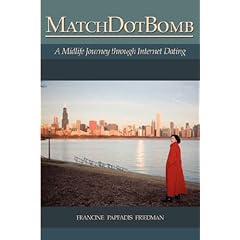
MatchDotBomb (Wheatmark, 2007) is not just for baby boomers; seniors and anyone curious about Internet dating should enjoy it as well. I have also reviewed this book on "Write your Life!" and on Amazon.com.

When fellow Chicagoan and IWPA member Francine Pappadis Friedman found herself widowed in her fifties, she was devastated. "When I got married years ago it was 'til death do us part.' I just never counted on that death part." Spurred on by two good friends, Francine, an attractive, hard-working professional woman and fifty-something mother of two grown children, tried the world of Internet dating.

Her encounters with a rogues's gallery of lonely men are hilarious; her dates range from the always-angry, cynical lawyer who sees a potential personal injury suit everywhere and the aging hippie with long white hair, earrings, tattoos, and a motorcycle to the extreme health nut, obviously much older than stated in his on-line profile, who talks only about his diet and exercise regimen. They are all there: the extremely needy, the seemingly deranged, the not-so-funny joker.

Along the way through her journey, Friedman also describes a trip to Greece when she was twelve. It was a family trip to the country and the tiny village where her father was born and raised. Understanding her heritage was important to her life journey, as was reflecting about her happy marriage and family life.

Francine Friendman seems to understand the men she meets very well, but this book is not really about Internet dating. She does not find her soul mate, but along the way, she finds herself. Discovering who we really are and what we really want and acting on that knowledge are what really matter. The author learns this lesson. Her book is about an awakening and about following one's own dreams.

Francine Friedman's web site is at http://www.francinepappadisfriedman.com

Copyright 2007 by Marlys Marshall Styne

Tuesday, July 31, 2007

The Benefits of "Elder Blogging"

This badge is borrowed from Ronni Bennett's premier senior blog, Time Goes By - What it's really like to get older at http://www.timegoesby.net.

I've often been asked by my contemporaries (and even by those slightly younger) both "What is a blog?" and "Why should I start one?" Both questions are more complicated than I at first thought, but I've always tried to answer, with a little help from other bloggers. This is strictly for the uninitiated, those who may read blogs but not write them.

Basically, a blog is a web log or on-line journal. It is also, in a sense, a web site or web page on which the posts are usually displayed in reverse chronological order. Older posts usually remain available in the archives. A blog is a wonderful forum for self-expression; readers are usually invited to leave their comments, and some interesting conversations occur on blogs.

A blog is also a do-it-yourself web page. A traditional web site ordinarily requires expert development and maintenance for a price; if the author wants changes, he/she usually must contact the web master and wait. Definitely lacking the expertise of a web developer or web master, I have been able to use free tools to develop this blog and another. If I make a writing or spellling error, I can edit my post immediately; on the web site I write for, I have been begging for a small punctuation correction in one of my columns for weeks, and it's never happened. Blogging is wonderful for the impatient, like me.

Blogger (http://www.blogger.com/) offers free blogs, simple instructions, and a large group of templates (or designs). Using a template may not strike you as very creative or personal, but if you've noticed, few blogs look alike. The secret is customization: colors, type fonts and sizes, side bar contents, and just about everything else. This is blogger heaven for non-programmers like me.There are many other blog development sites as well.

So what are blogs for, and why should you begin one? For one thing, a blog provides a good way to keep in touch with family and friends. People all over the world can keep up with your activities and your thoughts if they care to read your blog. For some families, a blog is a family reunion and a round-robin letter combined. Communication is instant, and it doesn't even require postage. Your family photos, your achievements, the big events in your life can be shared on your blog.

Blogs are used by businesses and political candidates and social activitists and even (unfortunately) by hate groups and purveyors of pornography. But for our older crowd, they can be live-saving. To quote from Ronni Bennett's blog, mentioned above, "Carl Jung described one of the seven tasks of aging as the need to review, reflect upon and sum up one's life. Most elders have a need to tell their story before they die." Jung himself wrote, "I try to see the line which leads through my life into the world, and out of the world again."

Writer Anna Quindlen wrote in her Newsweek column, "As the letter fell out of favor and education became professionalized, with its goal less the expansion of the mind than the acquisition of a job, writing began to be seen largely as the purview of writers." Telephone conversation is fleeting. Valuable insights are being lost.

I have spent a lot of time urging my fellow seniors to write their life stories; they have valuable experiences and lessons to share, and their children and grandchildren need those lessons and those memories. Remember how many people used to write long, informative letters and keep the letters they received from their loved ones? Today, few of us bother. However, we can now write as frequently as we wish to anyone willing to pay attention via e-mail or blogs. We can save the e-mails we receive.

A blogger named Steph writes to Ronni, "Having just celebrated my 5th year of blogging, I gathered up all of my archives . . . and burned them to a disc. They will be included in my will, just the same as my other writings . . . ." Whether or not we have any other writings (and I hope that most of us do), a blog can provide an easy, free way to record and communicate.

Frankly, blogging gives me a feeling of accomplishment. I can write whatever I want to, and if anyone cares to read it, it's available immediately. What's more, while my blogs do not qualify as great literature, they are parts of me that I can share and leave behind.

Copyright 2007 by Marlys Marshall Styne

Sunday, July 22, 2007

Quote of the Day

"Your vision will become clear only when you look into your heart. Who looks outside, dreams. Who looks inside, awakens." . . . Carl Jung, Psychologist

Wednesday, July 18, 2007

Writing Outlets for Seniors

As an advocate of writing for seniors, especially those who have never considered themselves writers, I am sometimes asked, "Where can I publish my work?" Of course we can submit our life stories, fiction, poetry, or anything else we write to the same web sites, contests, or publishers as anyone else, regardless of age.

Still, I like the idea of seniors writing for seniors. We don't always need younger people to give us information or advice! We need to examine our own lives and experiences and share them with our peers.

There are many web sites for those 50-plus. You can find them all with a search. But many of them emphasize on-line dating, expert advice, games, or any number of other things. There's nothing wrong with that, and many do offer individual journals, blogs, or web pages; each site has its strengths and weaknesses. However, I have two favorites for sharing my writing, not for money but for recognition and all the other rewards of writing.

The older of the two sites (but still relatively new) is eGenerations, "The Choice of the Experienced," at http://egenerations.com/ Of course I'm biased, since the site's co-founder and editor features and promotes my twice-monthly column about memoir writing there. This feature is quite new, but many members have already contributed various journal and memoir entries, and even fiction. Although this site welcomes anyone over 50, there are not a lot of us over-65 members yet. In a way, that's all right; we "oldsters" can help prepare the larger Baby Boomer generation for the future, and their ideas may help keep us young.

eGenerations is still undergoing development, and the editor listens to its members. We have a chance to help shape the web site with our comments, suggestions, even complaints. There are three other columnists, one on lifelong learning and two presenting "the lighter side." They do their jobs well. There are also videos and other features, with more coming. The site is easy to navigate, and if you have problems, there are videos to show you how.

If you're over 50 and want to try writing, join eGenerations and begin writing in either the memoirs or the journal section (which may ultimately be combined or renamed). You're likely to get comments and suggestions from me and from many other members.

The second site, very new, is The Elders Tribune, "Seniors Writing to Better Health," at http://elderstribune.com/. I assume that the "Better Health" being promoted includes both mental and physical well-being. This site is almost exclusively for the 65-and-over group, and its purpose is to welcome and present member-written articles and stories. The categories include Arts and Entertainment, Business, Fiction, Health and Spirituality, Lifestyle and Family, Non-fiction, Recreation, Technology, Writing, and Editorial, as well as an apparently all-inclusive "Other."

Right now, The Elders Tribune is offering its first contest, with a $100 prize for the best article or story. Readers will determine the winner with their votes. The winner must be 65 or older, although others may enter just for fun. The contest ends September 30, 2007, so there's still plenty of time to enter.

If you're at all interested, check out both of these sites; submit your writing. Writing and sharing your writing are, indeed, good for your health--and your happiness.

Copyright 2007 by Marlys Marshall Styne

Wednesday, July 04, 2007

Parade Memories and July 4th at Grandma's

My paternal grandmother lived in town, and that was exciting to me as a child. I grew up on a farm with visions of big-city skylines in my head; Whitewater, Wisconsin, did not qualify, but I considered it a step in the right direction.

The excitement there was the 4th of July parade. As I remember, it began on Main Street and turned down North Franklin street to the city park. Grandma lived on North Franklin Street.

I remember the joy of swinging back and forth on Grandma's front porch glider and admiring the passing bands and floats and marchers, feeling patriotic, and always munching on some snacks that my plump body surely didn't need.

As I look back, I realize that it wasn't much of a parade by today's standards. The "floats" began as farm wagons, trucks, cars, and even children's wagons, and the bands sometimes played out of tune. Still, the parade spirit was there. I loved the flags and the excitement.

As I recall, I've participated in only three or four parades during my lifetime. In those days on Grandma's porch, I dreamed of parading as an honored celebrity or Grand Marshal, but of course it never happened. In Whitewater, I wore an ill-fitting purple band uniform, played my clarinet, and marched with our fledgling high school marching band once or twice. Ours was the smaller of the town's two high schools, and as I remember, the larger one had a bigger, better band. I once rode on a farm wagon-based float that proclaimed "Education Reflects the Spirit of Liberty" on the side and featured an old-fashioned mirrored "crystal ball," dance hall style, in the center.

At Luther College, I remember riding on a homecoming parade float in a fancy new yellow gown. It rained that day, and what I remember best is that the dress was ruined by run-off from the blue crepe paper decorating the float. My parents were in the crowd to observe this spectacle. I can't remember either the theme of the float or the sponsoring organization, but it may have been either the drama group or the literary society.

Today, I enjoy parades vicariously on TV. I admire the flowers and the beauty of the Rose Bowl Parade floats, the hype and variety of the New York Macy's Thanksgiving Parade, and the marching politicians, commercialism, and enthusiasm of Chicago's many big parades.

Still, no parade quite provides the excitement of being "downtown" on Grandma's small-town front porch, swinging back and forth and eating. That experience was a generator of big dreams.

Copyright 2007 by Marlys Marshall Styne

July 6 postscript:
I just found pictures of this year's parade in Whitewater, Wisconsin! It appears that things have not changed as much as I imagined. To take a look, go to http://www.whitewaterbanner.com/

Tuesday, March 20, 2007

More on Writing Memoirs


First, some good news:


My book, Reinventing Myself: Memoirs of a Retired Professor, has been awarded first place in the Biography and Autobiography category of the llinois Woman's Press Association's Mate E. Palmer Communications Contest. I will receive the award in May at the IWPA's awards luncheon.


Also, I will be starting a new column for http://www. seniorsgrandcentral/www.eGenerations.com, probably on or about April 15, 2007, as part of a new feature to be called "MyMemoirs." This is a relatively new senior/boomer web site, and I look forward to contributing. Check out that site, especially if you're over 50. Membership is free.

A memoir from the past by a fascinating senior (see cover photo above):

R. Merle Funston was my stepfather, married to my mother, Violet Funston, during the last eight years of his life. During the final two years, while he knew he was dying of emphysema, he told his life story to my mother. She prepared the copy on an old typewriter; then she paid to have it reproduced in the original Courier typewriter font and published in a slim blue paper volume by Bireline Publishing of Newell, Iowa. Mother hurried to finish the book and begged for a preliminary copy she could read to Merle before he died. She said it seemed almost as if he was living to see the book published. A copy arrived in time, and she was able to read it to him. He was pleased, and asked her to read his favorite chapter, the final one, several times. Merle died on May 9, 1983, at the age of 75, just a few days after his book was published.

Merle Funston was born on July 1, 1908, in Hampton, Iowa. In 1912, the family moved to the farm where Merle’s father had been born in Jo Daviess County, near Galena, Illinois, to the neighborhood known as Irish Hollow. Merle’s life revolved about the Winston Tunnel and the Chicago Great Western Railroad.

"When I was a boy I often stood on top of the tunnel facing north. To my left I could see across the Mississippi into Iowa. I could also see the single track of the Chicago Great Western Railroad to the Rice Station just east of Blackjack Road. To the north, I could see the roofs of the buildings on my father’s farm."

The Winston Tunnel, a half-mile long, completed in about 1888, became a lifelong interest for Merle. Many of his memories revolved around the railroad and the tunnel. He remembered U.S. soldiers being stationed at both ends of the tunnel for about three months during World War I to protect the soldiers and supplies transported through it. The soldiers bought eggs, milk, and homemade butter from Merle’s mother. He remembered that when an uncle and some friends cut down a neighbor’s "bee tree" to steal the honey, they timed the tree’s fall so that the noise from a passing Chicago Great Western train passing the farm would cover the sound of the falling tree.

The last train passed through the Winston Tunnel in 1970. A few years later, Merle supported a group trying to establish a "Great Western Nature Trail" on the abandoned railroad right of way. He wanted the "atmosphere, the memories, and the beauty of the area" to be preserved. However, neighborhood property owners banded together to buy the land and defeat the nature trail plan.

This book reminds us of how much Midwestern life has changed. While most boys living in Irish Hollow at the time did not attend high school, Merle decided to do so as long as he could ride his pony, Bird, to Galena High School. He started out about six a.m. and "parked" Bird in a barn behind the grocery store. After high school, he worked for the Chicago Great Western Railroad for about ten years, and later became a farmer and cabinet maker near Stockton, Illinois, where he was living at the time of his death. He married and had a son, and was widowed in 1972. He married my mother in 1975.

In his conclusion, Merle states, "A ski resort, eating place, golf course, and fancy subdivision occupy the land where my uncle and I hauled walnut logs. The boys of Irish Hollow are probably watching television instead of listening to stories told by their elders or watching trains going in and out of Winston Tunnel." In fact, the tunnel was fenced off, the openings bulldozed shut in 1973, and parts of it collapsed later.

I did not know Merle Funston very well, but he was a nice, kind man whom my mother described as "always cheerful, always laughing, always telling his stories." Thank you, Merle, for proving that all of us, whatever our life circumstances or lack of fame, have interesting stories that need to be recorded, interesting lives that should be remembered.

This book is not generally available any longer, except possibly in local history collections in the Galena, Illinois, area.

Copyright 2007 by Marlys Marshall Styne

Friday, March 09, 2007

My Mother's Memoir

I spend a lot of time urging seniors to write the stories of their lives. I wrote and published mine in 2006. But where did I get the idea? It long ago occurred to me that my mother's unpublished life story, My First Eighty-Six Years: a Midwestern Life, which I edited and had printed for her in 1997, was my main inspiration. She distributed her life story to family and friends and to anyone who expressed the slightest interest; she was still giving copies to the staff at her nursing home a year or two ago, when she was able to communicate (she still clings to life at 95, but just barely). She has had an interesting life, and of course she was one of those people urged to write. I'm glad she did.

The picture above shows my mother, Violet Marshall Funston, with my brother and me, at her 90th birthday party in 2001. All three of us have changed since then, but my brother (now 72) and I are still active and relatively healthy.

Here are the first five paragraphs of My First Eighty-Six Years. I hope they will encourage other seniors to write their own life stories.

"There was a time when heredity was blamed for whatever was wrong with you. When I was old enough to spell and understand the word 'heredity,' I could only hope that the good, solid, God-fearing Methodists who were my mother's parents would somehow be the stronger influence on my character. As I grew older and wiser, I realized that I was much more like my father's family, and was thankful. They had lots of self-confidence, no fear of giving up a sure thing to try something new. My father taught me I could do anything I wanted to do, and that I should never be afraid to follow my dreams.

"As a child, I spent much time with my father's family and as little time as possible visiting my mother's parents. There was always something happening at my father's home. My father's mother, Harriet Bryant Uhl, was English, and being English, never missed her afternoon tea and cakes. Whenever possible, I joined her. She was short and wide and jolly and could always cure any ache I might have, real or imaginary, by holding me on her ample lap. Then she told me stories of her early married life in Pennsylvania where her eleven children were born, eight boys and three girls, without benefit of a doctor. According to Grandma, child-bearing was a natural process, and a healthy woman should be able to assume her full work load two or three days after childbirth. She didn't think much of the women who used childbirth as an excuse to get a week's vacation.

"One of my favorite stories that I asked Grandma to tell over and over again was about my father. My father had a slight limp, and I never tired of hearing Grandma tell how he got the limp. When he was a small boy, he accompanied Grandma to the woods near Johnstown, Pennsylvania, to pick blackberries. He had his own little bucket and picked and ate blackberries. One day, he became tired and sat down under a tree. A copperhead snake crawled into his lap. It frightened him, he hit at it, and the snake bit him in the ankle. Many miles from a doctor, Grandma sucked the poison out and saved his life. He was sick for many months. He would have been in third grade, but he never attended school after that. His mother taught him. She not only taught him reading, writing, and arithmetic, but in the process taught him religion, kindness, and good work ethics. His greatest wish was that both of his children, my brother and I, get good educations, and we did, in spite of some obstacles.

"According to my Aunt Mary, Grandpa Joseph Uhl taught rural school in Pennsylvania when the eleven children were small, and sat evening after evening at the neighbors' home talking, singing, and playing the violin. Grandma did the work on the farm, including milking, raising pigs, raising chickens, and gardening. She got the help of a neighbor when it was necessary to take a few days off to have her babies. She taught the children to help when they were small. To Grandma, farm work could not be done by an educated person such as Grandpa, especially one who played the violin. I never knew a happier person than Grandma, and she raised a happy, well-adjusted family. Ten of her children were God-fearing Catholics who married well and earned their share of this world's goods. Unfortunately, one son was an alcoholic. His wife divorced him and took the two children, and he came home to live with Grandma and Grandpa. Grandma never got over her one failure in raising a child, always blaming herself. Many a time I heard her ask, 'Where did I fail with George?'

"As I grew older and listened to the champions of women's liberation, I thought of Grandma, always strong, always happy, meeting all her problems head-on. Thinking of Grandma gave me courage. It is always nice to have someone to help you, but if there is no one available, you can do it yourself."

While I can't endorse the "woman as martyr" view expressed here, nor have I ever shared it, I am happy to belong to a line of strong women. Most of all, I am happy to have had a mother who loved to read and write and encouraged me to do the same.

Copyright 1997 by Violet Marshall Funston and 2007 by Marlys Marshall Styne
Photo from John C. Marshall's family collection.