Monday, August 21, 2006

Going Home Again, Part I: Is this Progress?


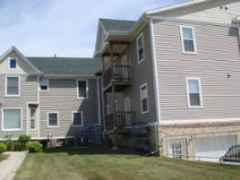
Top: Front view, the
original house today,
refurbished.

Bottom: Side view,
showing the addition.


On Sunday, I decided to take a closer look at my old farm home on the outskirts of Whitewater, Wisconsin. I knew that it had been turned into student housing many years ago, so I assumed that the house I remember as both beautiful and shabby was gone.

The house still stands on a curve in the road. From the west, the front looks beautiful: much the same, but refurbished quite attractively. The trees are not the ones that were there fifty years ago, but there are trees, as well as flowers. Of course the barn and other farm outbuildings are gone, replaced by new streets and small apartment houses.

Were this the only possible view, the house would seem to be a well-preserved version of the house I grew up in, but then there are the north, south, and east sides. There, a huge, box-like apartment building is attached, with multiple garages facing south. I suppose all this is progress, but my old home is gone.

Copyright 2006 by Marlys Marshall Styne
Photos by the author

Sunday, August 20, 2006

Going "Home" Again, Part II: My High School Reunion Picnic, 8/13/06

Last Sunday, I journeyed into the past. Like Thomas Wolfe and many others, I have dealt with the question of whether one can go home again, and both question and answer grow more complicated as time passes.

The home I sought last Sunday was the one I left at the age of seventeen, when I went away to college. That was fifty-six years ago, and other than a few summer vacations and short visits long ago, I never lived there again. The occasion was the annual reunion picnic of my old high school, Whitewater (Wisconsin) College High School.

The school, a "training school" for what was then Whitewater State Teachers College (now the University of Wisconsin at Whitewater) closed fewer than ten years after I graduated, so there are no new graduates. The surviving graduates are all senior citizens now. This picnic is canes and walkers and 40's and 50's music, not frisbee-playing and young children. This year, there were two or three attendees who graduated in the late 1920's, before I was born, so this group almost makes me feel young again.

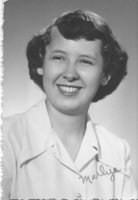
With class sizes under thirty students (ours wasn't the only high school in town), we were and are a small group. I was the only reunion attendee from the class of 1950 (see my graduation photo above). Last year there were three of us (of the original twenty-one). I know that four or five class members are deceased, and one is recovering from an operation, but I wish more of the others had attended.

Anyway, the reunion was well worth the approximately one hundred mile drive. I joined five or six members of the class of 1951 and one from my brother's class of 1952, only one of whom I've kept in touch with, and enjoyed a bit of reminiscing. It was no surprise that most of the others enjoyed their high school days more than I, the ultimate shy nerd, did. I can laugh at my old self now. For me, high school was not "home."

Physically, the school no longer exists, and in my memory, it grows more remote as the years pass. Home now is Chicago, and returning here required only a drive in heavy traffic. I didn't mind that, and I'll probably attend next year's reunion picnic.

Copyright 2006 by Marlys Marshall Styne
Saturday, August 05, 2006


Senior Moments
times two: Self-Help and Inspiration for Seniors

Book Reviews:

For seniors looking for self-help, inspiration, or just indications that the writing world cares about us, two books I've just read, with identical titles but different approaches, are certainly worth reading.

I. David Wayne Silva’s Senior Moments: Getting the Most Out of Your Golden Years (Outskirts Press, 2005) is a self-help book and an autobiography by a senior citizen for other seniors. This book is a series of appropriately-titled chapters about the inevitable challenges of aging and the experiences of the author and his friends in dealing with them.

In the first chapter, “Thoughts on Time,” Silva writes, “Time that seemed endless in our youth now flies by with brutal resolution.” However, one positive aspect of aging is that mentally active seniors learn to savor every moment. “We see beauty in people, flowers, sunsets, and our animal friends,” becoming more aware of the beauty that surrounds us. This book shows how Silva and his friends have done exactly that. The author offers a great deal of practical advice.

In chapters including “The Christmas Tree,” “Another New Year’s Day,” and “Valentine’s Day,” Silva deals with loss and how to find comfort on what could be lonely, depressing holidays. He finds comfort not only in memories, but in observing flowers, pets, even squirrels, and listening to crickets around him. He also finds comfort in his strong religious faith and includes a short prayer at the end of each chapter, yet he does not claim that religion is the answer for everyone.

Toward the end of the book, Silva mentions his own serious health problems in “On Sleepless Nights,” “Thoughts on Pain,” and “Chronic Illness,” but with few complaints. He retains his focus on the positive side of aging, emphasizing in another chapter that “Living Means Growing.” He suggests that we ask ourselves, “Am I still growing? Have I given in to aging and the conditions that growing old brings to our lives?” This book will help the senior reader who answers “No” to the first question and “Yes” to the second to improve his or her life.

Californian David Wayne Silva, a former teacher, school administrator, and family and grief counselor, comes through as a friendly, outgoing, caring senior I would like to meet and talk with. This book should appeal to and comfort anyone old enough to be thinking seriously about the problems of aging, issues almost everyone will face eventually.


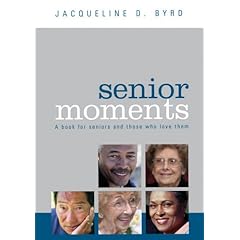
II. Senior Moments, subtitled “A book for seniors and those who love them,” by Jacqueline D. Byrd (Byrd & Byrd, 2005), is based on the author’s weekly “Senior Moments” column, originally written for two Maryland newspapers. Mrs. Byrd is more Baby Boomer than Senior Citizen, but as an attorney specializing in Elder Law, she is eminently qualified to advise seniors and caregivers on various issues such as estate planning, health care, senior housing, and other challenges ranging from how to tell when it’s time to stop driving, how to avoid scams and frauds, and how to recognize and deal with elder abuse to how to remain active and stay happy into old age.

This book is full of valuable information; the author cites and quotes various experts on aging and legal issues, and includes a detailed table of contents that makes finding specific topics and resources easy.

The final chapter is more personal as Byrd discusses her own “extraordinary” mother and grandchildren and her coming sixtieth birthday. There, she contemplates “the realities and the mystery and blessing of growing older.”

There are many opportunities for seniors, but, writes Jackie Byrd, some seniors won’t consider volunteering at a senior center, moving to assisted living when it’s needed, or joining senior activity groups because “old people are there.. . . So, unneeded, they waste away, full of sadness and regret, feeling misunderstood and unloved.” Anyone who reads Byrd’s book carefully and heeds her advice can avoid such a fate.

Copyright 2006 by Marlys Marshall Styne

Sunday, July 30, 2006

Show and Tell

My first photo album (one of many) dates back to the late 1930's. The first photo in the album, apparently taken at school when I was about six or seven and in the first grade, shows me standing behind a desk and in front of a blackboard, hands on my hips (or what would later become hips), staring straight ahead with a look of pride and determination that seems to say, "So there!" or "Look at what I did!"

My dark hair is in long corkscrew curls, held back by a small barrette of some kind. I am wearing a plaid dress with a light background, but of course the photo is in black-and-white, so I can't tell what colors are in the plaid. I hope it was at least partly red.

Behind me on the blackboard is my artwork: a primitive chalk drawing of my first cat, consisting of a circle for a head, triangles for ears, an oval for a body with short, straight lines sticking out on all sides to represent fur, plus a tail. Under the drawing, in crooked small-child-style printing, is my cat's name, PURRCILLA MEWRIEL. I don't remember Purrcilla, but I assume that her name came from one of the books my mother read to me so often. She loved cats, and so did I.

That picture was taken by my teacher about sixty-seven years ago. I no longer remember the teacher or the occasion, but I love the picture and would never throw it away, despite its torn and faded condition. I have a few earlier snapshots from my mother's album, but this one is the first that shows me on my own, facing life without a parent or anyone else visible.

In this picture, I see pride and independence and determination, as well as a plump face suggesting my lifelong weight problem. I was probably shy and reluctant to participate in that show-and-tell exercise, or whatever it was called then, but once I'd finished my creation, I was obviously proud of it. I see the picture as a primitive metaphor for my long life: I've never been confident about doing anything, and yet having done it, I've been proud and rather defiant, being surprised by any appreciation or praise I've received. I've also appeared arrogant sometimes, my way of hiding my shyness, and I see that in the snapshot too.

I don't know what my classmates thought of my presentation; they probably concluded that I would never be an artist (I still can't draw). They probably wondered why my cat wasn't named something simpler, like "Fluffy." Perhaps my inner writer was already emerging.

I doubt that I was yet planning to be first in the class and graduate as valedictorian about eleven years later, but I like that look of pride and determination. Still, if I could talk to that child today, I might say, "Lighten up and smile, little girl. You'll make it!"

Copyright 2006 by Marlys Marshall Styne

Thursday, July 27, 2006

On Writing a (Short-Short) Story in Twenty-Four Hours

The weekend brought the summer WritersWeekly 24-hour Story Contest. I'd won the $5 entry fee as a grab bag prize in the winter contest. I'm no fiction writer, but I enjoyed the first contest, so why not try again?

The topic seemed crazy to me, something about teenagers on a bus encountering a man carrying a mysterious black bag. However, I put my imagination into gear and took advantage of the contest's flexibility: according to the instructions, I could change the characters' ages, etc. I made them senior citizens rather than teenagers, and I was off! I like the idea of a time limit and deadline, since there are so few of either in my life now.

It's strange how the story just started to grow, with a touch of mystery and the supernatural. The result was "Mysterious Journey." I probably won't win the contest (results are still a month away), but I'm beginning to feel more like a writer. I plan to try more short fiction. Perhaps fiction has always moved me more that real life. My feeling of triumph didn't require winning; it involved finishing something I can be satisfied with.

Copyright 2006 by Marlys Marshall Styne
Saturday, July 15, 2006

In the Media: Brit Lit Rises Again

Yesterday, I found two articles in the Chicago Tribune relating to English literature, to old classics among the many that I tried to convince my community college students were worth reading.

Actually, the news item, relegated to the sixteenth page of section one, wasn't very surprising: "At auction, Bard brings $5 million." As Barbara Gaines' thriving Chicago Shakespeare Theater shows, Shakespeare has never really disappeared from the scene. And this rare copy of the First Folio, the edition in which Macbeth and Twelfth Night were first published, was bought and sold at Southeby's in London.

That's appropriate, and the US has its rare book collectors too. I guess I appreciated the description: "Widely regarded as one of the most important books in the English language." I also imagined my former students asking, "Why would someone pay that much for that book?"

The other article, in the Movies section, was more surprising. It was headlined, "Ancient epic poem Beowulf seen through a modern prism," a review by Michael Phillips of Beowulf and Grendel, and it gets two stars. Reviewer Phillips calls it a mixed-up and unbalanced picture, made nearly worthwhile by its filming location in Iceland and "the bone-white sea creature--Death, glimpsed only as a forearm with clawlike digits--who appears now and then..."

Apparently, in a revisionist heightening of the poem's tensions between pagan Norse legend and Christianity, Grendel "becomes a victim of blind, brutish racism." Who's the hero, Beowulf or Grendel? Reviewer Phillips also criticizes the "dizzying variety of accents" brought by the Scottish, Swedish, Icelandic, and Canadian cast (Gerard Butler, Steffan Skarsgard, Invar Sigurdsson, and Sarah Polley).

The review doesn't mention Grendel's mother, another impressive monster in the original epic. Perhaps director Sturla Gunnardson left her out. I may have to see this film to find out. When I first read this epic many years ago, I especially liked the idea of a female monster.

In my mostly unsuccessful efforts to revive traditional Brit Lit survey courses and Beowulf seven or eight years ago, I emphasized the modern-day appeal of monsters. Perhaps I would have been more successful emphasizing racism and discrimination. It's much easier to hate racism and discrimination than today's almost cuddly "monsters."

Anyway, I'm glad to see that Beowulf and Grendel have been revived once again.

Copyright 2006 by Marlys Marshall Styne
Thursday, July 13, 2006

It's Never Too Late!


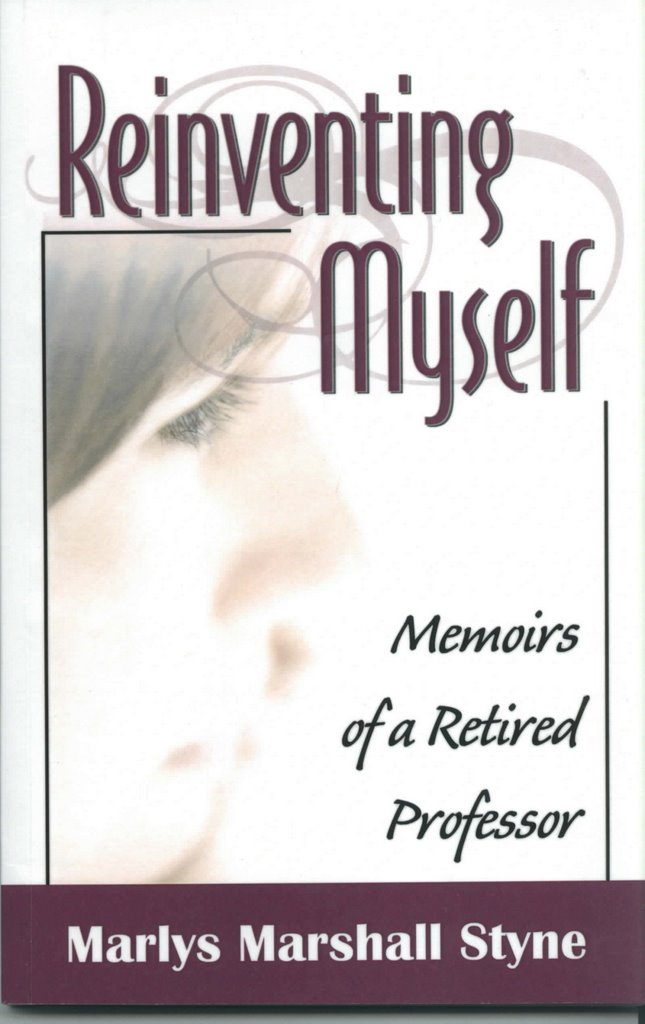
Opening the small package to find three beautiful proof and copyright copies of my own book, with my name on the front cover and my picture on the back of each, was a major highlight of my life. When the books arrived in early May, 2006, it was more exciting than winning a lottery. I hope most writers don't wait seventy-some years for this experience, but there is really no time limit. It's never too late to write and publish a book, as I have proved. My book is Reinventing Myself: Memoirs of a Retired Professor (Infinity Publishing, May 2006).

I was a long-time community college English teacher. I've heard that most English teachers are either frustrated actors or frustrated writers, and if so, I belonged to the writer group. However, I did not teach at a publish-or-perish institution, and I kept very busy grading papers and preparing classes and serving on committees. In my last seven years of teaching, I was a busy department chair. I wrote and published a few short teaching-related articles, and I enjoyed doing so, yet I didn't feel like a writer.

To me, being a writer meant writing incredibly beautiful prose that flowed easily from pen or computer into beautifully-printed works of art. I admired authors from Shakespeare to Dickens to Twain to E.B. White, Alice Walker, and hundreds more. Yes, I really knew that writing involved hard work, but I chose to ignore that. I lacked the courage to try.

The turning point came in late December, 2005, when I returned from a pleasant holiday visit with extended family in Texas to an empty condo. By then, I had been retired for seven years and widowed for six. My beloved old cat, Lyon, had died at an animal hospital while I was away, and now I was really alone.

In an Internet search, I found StoryStudio Chicago, and since the beginning creative writing classes were filled, I enrolled in LifeWriting. I decided to write about what I know best, my life. The class motivated me to write and keep writing for eight weeks. I enjoyed sharing my work with my younger classmates, and I enjoyed hearing their work. Completing a book in eight weeks was not the assigned goal of the class, but I tried it anyway.

I had plenty of time to write, and writing, especially in the early morning hours, seemed to revive me. Words did not flow from my pen or computer in perfect order, but I revised and edited and revised again. I filled my wastebasket many times with discarded attempts. I also rediscovered a few essays I'd written as early as 1988, as well as a lecture on poetry and a commencement address I'd given in 1996. I began to envision not a chronological story of my life, but a series of personal essays old and new that told my story and encouraged others to write.

I really wanted to publish this book, but I realized that traditional publishers would not be eager to take a chance on a memoir by a new, unknown, elderly writer. For me, becoming rich or famous was not a priority, but of course publishers are in business to make money, as they must be. I began to explore the complicated world of self-publishing. Self-publishing had always been treated with disdain in my academic world, and I'd heard horror stories of exorbitant fees and writers' basements full of low-quality, unsold books. Still, computers seem to have changed the self-publishing world.

I discovered that I could publish my book for a reasonable fee that included cover design, retain all rights, and avoid any requirement to purchase copies. Of course I got no free copies beyond the proof copies either, but I didn't mind that. I could buy five or ten or one hundred copies as I chose, my first order at half-price and future orders at forty percent off. If the book sold, I would get modest royalties, even for those copies I sold myself, and if it did not sell, I was out only what I had already paid. Books, in addition to a very small publisher's inventory, could be printed on demand very quickly, and the book would never go out of print unless I chose to withdraw it, which I could at any time. I would be free to go to a traditional publisher if one showed interest later.

For me, independent former English professor and computer enthusiast that I am, it was thrilling to format the book myself according to the publisher's specifications, scan my own pictures, do my own editing and proofreading (with marvelous help from a friend), and submit my book in PDF format on a CD. I had total control. I didn't need to pay for editing or proofreading or formatting, although they are available and may be necessary for some authors.

That beautiful proof copy contained a few errors, of course. Still, making the corrections in my original Word file and submitting a new PDF disc was easy. I won't claim perfection, but except for one unintentionally convoluted sentence and one minor typo, I haven't found any errors in the finished book. I'll trust my readers to find any others that remain.

My book was finished by late March, the proof copies arrived in early May, and my book was published on May 24. I know it won't be a best seller, but just seeing it mentioned on various Internet sites is a thrill. The sales results will come later, but I've already achieved success on my own terms.

For me, self-publishing was a good experience. Seeing the proof book and then the final copies, selling a few copies myself, talking to old and new friends about the book, learning about promotional possibilities on various web sites: writing and publishing restored my enthusiasm and my enjoyment of life. That's why my title begins with "Reinventing Myself." I hope others will follow my example. It's never too late.

Copyright 2006 by Marlys Marshall Styne